Sunday, December 29, 2013

Roster Addtions

As a final blog entry for 2013, I have put two new locomotives in service, which will help round out the roster for operating sessions.  Both are factory-painted models to which I added details, weathering, and decoders.  First up is Conrail 6345, a nice model of an EMD SD40.  I added lift rings, the cab roof antenna, grab irons, numerous warning decals, a snowplow, and weathering to this unit.  Here's the 3/4 view:


And, a broadside:


Finally, for the 6345, a cab-level shot showing some of the details and a closer look at the weathering:


Also, at the request of several regular operators, I went ahead and put another run-through unit in service, the first SP locomotive I've ever finished.  SP 7427, a model of EMD's SD45, is ready for service!  SP power was relatively common on the Chicago Line in the early 1990's, especially on certain trains:  TV-556, TV-79, and SLSE.  This will be a nice compliment to the various D&RGW units I already have in service.  We will start with a 3/4 view:


This is an Athearn model in their 'RTR' series, and boy, I am impressed with the details right out of the box.  All I added were a few extra grab irons per the prototype, drop steps, windshield wipers, and lift rings; the rest was pre-applied at the factory.  This was also an opportunity for me to extensively use pastels for weathering, and that was how I obtained the look of the worn paint underneath the dynamic brake blister.  A broadside shows this better:


On SP and D&RGW, long, steep grades necessitated extensive use of the dynamic brakes, which created a lot of heat.  That heat was blown out through the grids above the lettering, and over the coarse of years and  years, and thousands of trips on steep hills, paint would fade and blister.  In many cases, you would see the base coat of red beneath the gray, which is what I modeled here.  Further, SP of the 90's was a cash-strapped company, and their image suffered as a result.  Their power was filthy unless it was brand new!  To capture that look, I airbrushed the unit with various washes and made heavy use of pastel chalks.  A cab-level view:


Just to show how much weathering was done, take a look at the photo below - this was how the unit looked straight out of the box:


With that, I close the blog out for 2013, with excitement for 2014 and years to come.  2013 has been a fantastic year for me personally and for the Onondaga Cutoff, too.  I am thankful for my family, and especially my patient, strong wife, and for our beautiful, happy little girl.  It's a blessing to be able to make this kind of progress on a model railroad, and to share that with you here and also through regular operating sessions.  This model railroad brings people together and is a lot of fun to build.  For me, this is what the hobby is about.  

Best wishes for a healthy, happy 2014 to you all!  

~RGDave


Thursday, December 5, 2013

Coming Together

With some downtime ahead of the holidays and before the last signal bridges arrive, I decided to get the last of the local control panels (LCP's) in place.  The last two to go in were at CP294 and CP295, and to install those, I needed to install the permanent fascia board at the same time.

This took more thought than I had planned on - it was difficult to visualize how it would come together, as I did not make the original stringers long enough.  After quite a bit of time staring, beer in hand, at the issue,  I came up with an idea to build a new 'backbone' for the edge of the layout.  To do that, I needed to hang some timber girders to provide direction and support for the LCP's and the fascia.  I built L-girders out of 1X3 lumber, and fastened those girders to the existing stub-end stringers; with some careful measuring and fitting, I had my finished product.  Here's another view:

The fascia provides a nice, hard, definite edge to the layout, and finally defines the area that needs scenery.  We are approaching a stage of construction that will be primarily devoted to scenery, and I am looking forward to that.  That's where the magic really comes to full view!

Merry Christmas, Happy Hanukkah, Happy Holidays to all!

~RGDave

Friday, November 15, 2013

A Fresh Look

Model railroading is a life-long hobby for those that choose to make it so.  I would argue that, compared to other hobbies, model railroading offers enjoyment at various levels, which is one angle that makes this hobby so great.  When you are a beginner, just starting out, the hobby is entertaining.  As you grow in the hobby, your skills and vision become more refined, and you can take it as far as you want to take it.

One example of that is my 3279.  This is a classic engine that I purchased in 1989, manufactured by Athearn Inc. in Compton, California.  This was part of their regular lineup and was painted at the factory in the Conrail livery.   Even at that time, I was interested in detailing locomotives and so I added several parts to the model to more closely represent the 'real' Conrail 3279, formerly a Reading Company GP40-2.  This meant that I needed to change the size of the fuel tank, add a cab-signal control box, snowplow, lift bars, and MU hoses, paint & decal the number boards and handrails, and weather the engine.

As my skills improved over the years, the 3279 started to look shabby in comparison to models I had finished more recently.  Other parts became available.  My research showed me ways in which I could further improve the model.  And finally, the conversion to DCC several years ago presented a great opportunity to take another hard look at the old 3279, and bring it up to modern standards.  Here's the result:


Without much doubt, this is the best this model has ever appeared.  Details make the model, and the correct fuel tank, the angled 'rain gutter' on the roof, smaller decals on the frame and nose lettering, and additional weathering all combine to create a more plausible model.

This hobby will grow with you.  There remains much to learn, of course; still, it is satisfying to see that, with some work, a model that stood out as being an early effort can be upgraded to fit better with the rest of the fleet.

~RGDave

Tuesday, November 5, 2013

Car-Forwarding & Freight Movement

After the Train Plan, the other central piece of paperwork in any operating session on the Onondaga Cutoff is the car-forwarding plan, as designed by Jack T. and Rich W.  Based on my research and layout space, I had come up with several industries loosely based on prototype facilities on the Chicago Line.  While not exact replicas, these industries are built to approximate the feel of some of the online industries that Conrail (and Syracuse-area shortlines) served.  This worked as we got sessions started two years ago.

However, yard traffic naturally ebbs and flows and due to the yard’s capacity of approximately 75 cars, and we realized quickly that things can get rather unmanageable for the Yardmaster as there was no set plan that allowed operators to plan ahead.  Nor was there any consistency to when the setouts and pickups were made.  Jack and Rich therefore took the loose plan a step further, devising a full interchange plan to accommodate where these cars would have come from and how they would be forwarded back. 

This plan has become the network behind the operation, assigning each and every move through Onondaga Yard a specific set of orders that are incorporated into switch lists and interchange manifests.  All trains that work the yard are on this sheet, as well as every industry, and the time the train arrives and leaves.  In the matrix are the car counts and types, helping operators keep track of their moves.  It appears complicated, and it was to create; however, operating with it is actually much simpler than it looks, and the entire operation is smoother now.

Now, it’s the key to the whole operation, and we’re learning more about it with each session!

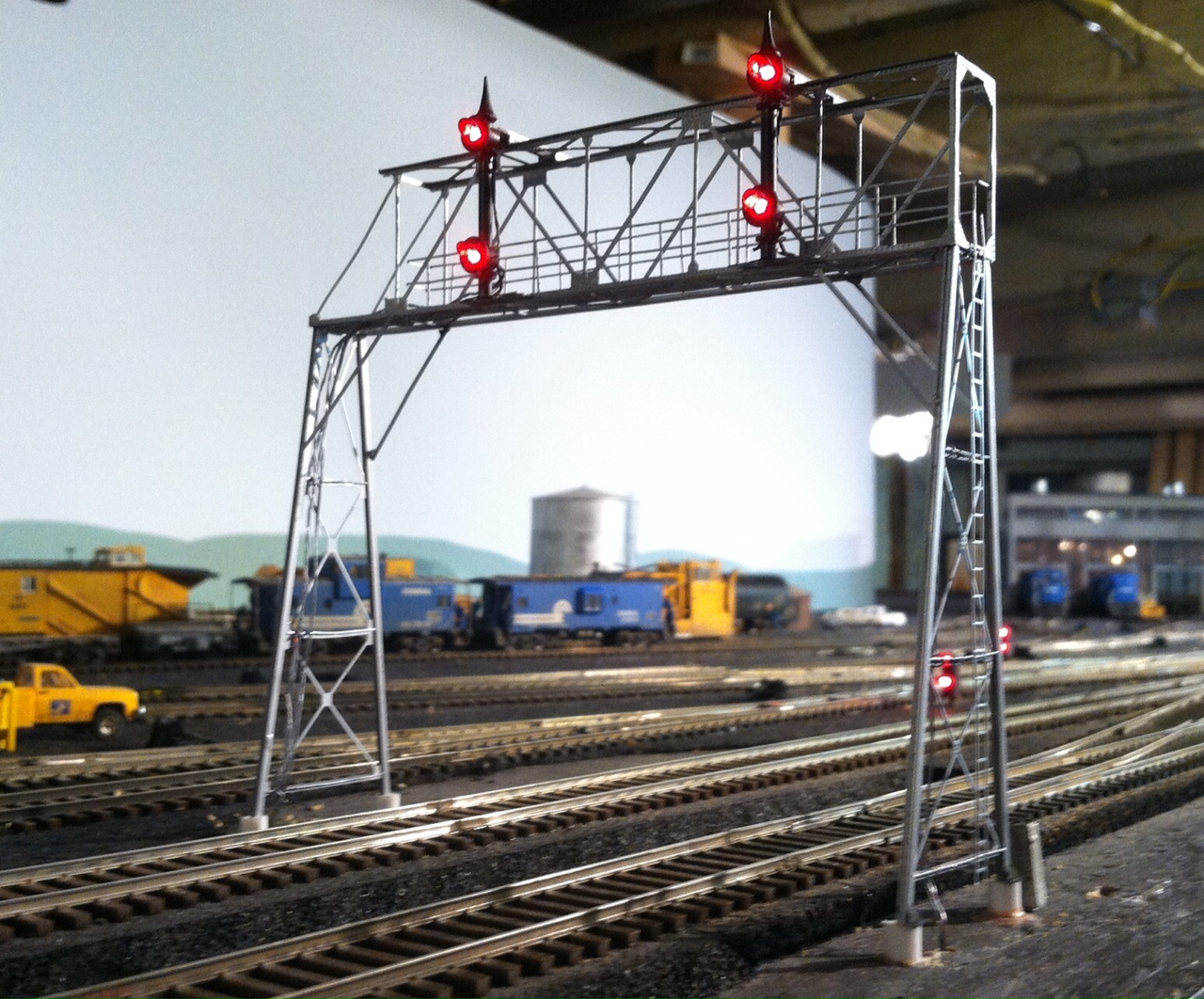
Finally, an update for you on the signal progress:  the final 3 signal bridges are under construction this month, and should arrive before the end of 2013.  That will complete my order with Integrated Signal Systems.  With all the remaining hardware on hand, the completion of the signal system is just a few months away, and a dream of a fully-signaled, dispatcher-controlled mainline will be a reality.  These are exciting times!

~RGDave

Monday, October 14, 2013

The PLAN

Realistic operation on a model railroad requires more than just running trains on a nice-looking layout with realistic locomotives and cars. While those parts are components, and certainly add to the experience, the operation aspect is based on a plan. Since real railroads move freight and people according to a plan, we need a plan to model that operation.

Just as in reality, the plan is the basis for the trains that run in any given session. Therefore, here is our master plan - the master schedule that has been created to best represent a full 24-hour period of traffic that would have run on the Onondaga Cutoff (i.e., traffic that did not work Dewitt Yard), in 1994.

There's a lot that went into this - a base list of trains that I provided, hours of research by Jack using Conrail schedules from 1993, 1994, and 1996 to determine what time those trains would have been scheduled through my railroad, and - perhaps most importantly - experience running trains on the layout.

This is the key to all the other paperwork we use. Next time, we'll take a look at the other vital piece - the car-forwarding system.

In the mean time, enjoy the autumn! Lots of projects coming up soon on the Onondaga Cutoff.

~RGDave

Friday, September 20, 2013

On Operating Sessions...

A photo for you all:  It’s 4:25 a.m. on September 14, 1994, well before dawn, at CP 277 on Conrail’s Onondaga Cutoff.  The Mohawk Dispatcher has lined TV-8W, an eastbound stack train from Chicago to Worchester, Massachusetts, on Track 2 around WADE-30 (stopped at left) and SEEL, whose headlight is visible in the distance.  TV-8W's approaching headlight illuminates the signal bridge for just a few seconds.


One thing that has surprised me over the course of the development of the Onondaga Cutoff is how much satisfaction I take from hosting an operating session.  In the past, I’ve always enjoyed the building part of the hobby.  Operations was something that came later, largely thanks to my interest in prototype operations, and the steady influence of Jack, my longtime friend and partner in all things railroad.  During the design phase of this layout, it was apparent that this project would be much larger than any I had constructed before, and therefore could be fun with multiple operators.  Still, I generally imagined running trains myself more than I thought about any organized operations.  That changed in a hurry after the tracks were in place and operational!   It was quickly apparent that some sort of organization was needed to avoid chaos.  Paperwork was part of the operation from the beginning, but has taken on a critical role for each session now.  Thanks to the fact that the track design is as prototypical as the space would allow, operations really came very naturally to the layout. 

Over the next few blog entries, I plan to present some of the paperwork we use to make it all happen.  Once a month, the Onondaga Cutoff comes to life, and for a few hours, it feels like 1994 all over again.

~RGDave

Monday, August 26, 2013

CP 280 is Online!


As hoped, the cut-in for CP 280 went smoothly, and despite there being 15 heads and 5 turnout combinations to program and wire up, all of those tasks were completed in one evening.  Below is a photo of the eastbound home signals at CP 280, including those on the bridge for the main tracks as well as dwarf signals beyond, protecting the North and South Running Tracks.


The Local Control Panel was installed in the several days after the cut-in.  As of this week, the interlocking is complete except for scenery.  Exciting progress!


We are aiming to make more progress in the signal department over the next month, before the next operating session.  Much of the hardware and signals are on-hand to complete the remaining work; all that remains to be delivered are the final 3 signal bridges for CP 282 and the automatic signals in Camillus.  Integrated Signal Systems will be delivering those to me within the next few months as well.

Step by step, we are getting there!

~RGDave