Showing posts with label CP 282. Show all posts

Thursday, January 20, 2022

Minoa & Euclid - On the Cover of Railroad Model Craftsman!

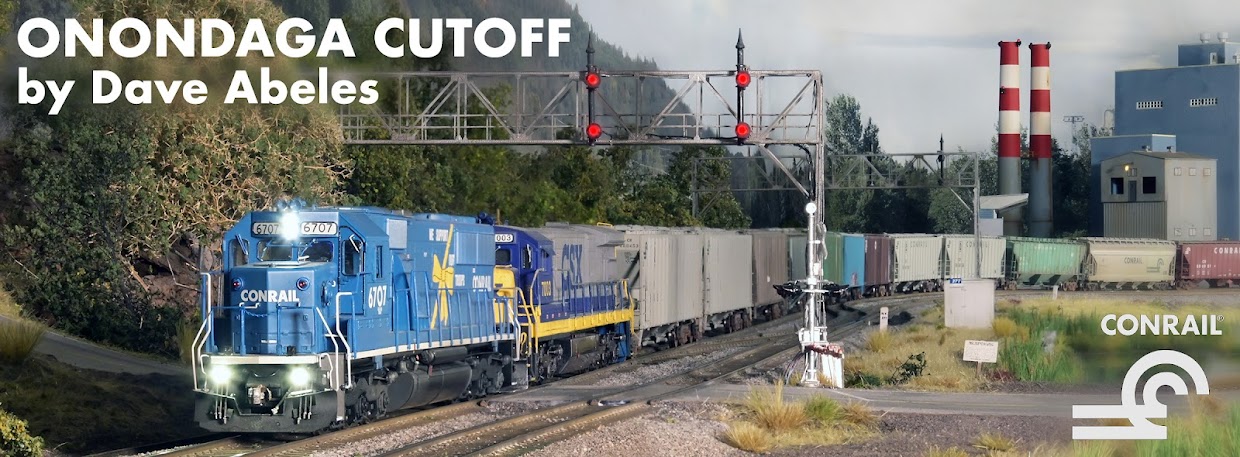
The Onondaga Cutoff is known for is Conrail operations, and now it will also be known for one of the roads that interchange with Conrail - the Minoa & Euclid, a Morristown & Erie-owned shortline on former DL&W track.  And, it's now featured on the cover of Railroad Model Craftsman!


This is a thrill, and a surreal honor to see M&E Alcos at CP 282, crossing the Conrail main line enroute to interchange at Onondaga Yard on the cover of an international model railroad magazine!  I am grateful to RMC editor Otto Vondrak for his vision to feature this part of the Onondaga Cutoff in Railroad Model Craftsman.  The story behind the cover photo is a first-hand account of fans chasing the M&E's day job, ME-1, while they work at Euclid Yard to switch the Peter Doelger Brewery and then make their interchange run to Conrail and return.  You'll meet the crew and follow the train over the route all the way to Onondaga Yard and back.  

Also interesting Central New York State content in this month's RMC is the article on kitbashing an interlocking tower - this one labeled for East Syracuse, SY Tower, which is up at Dewitt Yard on the prototype not far at all from the Onondaga Cutoff main line.  

It is an exciting time for the Onondaga Cutoff - thanks for all the support!


Thursday, May 13, 2021

Upgrading the Tower at CP 282

 A continuing vision for the Onondaga Cutoff is to 'Let Experts Be Experts.'   We've discussed that before, and it is manifested in different ways.  Skilled hands helped with benchwork.  Trusted advice from Model Railroader and Railroad Model Craftsman guided track installation and wiring.  Computer and IT experts helped me with networking.  Signal professionals did the signal design and guided the installation.  Transportation Planning professionals designed the car-forwarding and locomotive distribution systems, and design each operating session.  The list goes on, but it is clear that the total is much greater than the sum of the parts.

Recently, I had been searching for a suitable permanent model at CP 282 to represent an old NYC tower, repurposed as an office.  My vision was to model the tower that once stood at SJ interlocking, which became CP 293 under Conrail's tenure.  Al Tillotson, a talented modeler and regular operator on the OC, had contributed a foam-core and photo-printed stand-in that was suitable for its purpose for the last several years.  However, my goal was to model the brick and mortar construction from the 1930's as NYC upgraded its route through Syracuse.  


SJ was a critical interlocking that included not just the Water Level Route mainline but also the old Auburn Main, the Freight Bypass to the north, and the Lackawanna Oswego main line and interchange - plenty to keep the operator busy.   By the late 1950's though, NYC was installing new Centralized Traffic Control on its main routes, which allowed interlockings to be remote controlled from many miles away.  This made the tower operator and manual interlocking redundant.  The machinery was removed in the late 50's but the maintenance crews continued to use the tower as an office for decades to follow.  By the mid-90's, though, the end came and the structure was demolished.  

I worked with Perry Squier, a local modeler and expert scratch builder, to move forward.  Perry offered to build the tower if I could find plans.  Through the internet I came in contact with a former Conrail employee that - believe it or not - rescued the actual blueprints for this tower from a dumpster.  Amazed, I reported back to Perry who was surprised and pleased that we'd located the actual plans.  I made copies and Perry got to work.  


Perry asked that I do any interior detailing, which I did during a test-fit of the structure.  I also added lighting before returning the project for completion.  Perry delivered the final structure after several months of work, and I installed it on the layout - what an improvement!  

This adds a tremendous amount of NYC heritage and flavor to a scene that was already nearly complete.  The old tower was removed, and will be headed for my boy's layout in the attic, thanks to Al's generosity.  The new tower does an amazing job at night!

Another example of collaboration that turns out for the best: asking experts to help has made this layout greater than it could be if I were doing it myself. 

Monday, April 19, 2021

Sweeping Vistas

 Now and again, it's nice to make a few images of the layout and of some of the longer and more sweeping views that are possible with a basement-sized layout and photo backdrops.  Views are even more satisfying when you consider how much time and effort has been spend behind the scenes in the last few months with major construction projects!  Here's a few recent efforts:

Amtrak 276 meeting SEIN at CP 280, Onondaga NY

BRSE at CP 282, Onondaga NY

By combining high F-stops for depth of field with Helicon photo-stacking software, you can really create some memorable images around the layout.  Looking at photos like these takes me back in time to warm days along the tracks on the prototype, waiting to see what the railroad would run past me.  It's a soothing experience to let the mind wander using the layout as the medium!


Thursday, February 18, 2021

Going Back, For the Future

Winter has arrived here in New Jersey, and with it more time for modeling and for working towards getting several projects moving forward on the Onondaga Cutoff.  

First among those is a new tower for CP 282, which has long been a goal of mine.  The stand-in, generously constructed by Al Tillotson from foam-core and prototype photos has worked well well for several years but a permanent replacement is needed.  Thanks to the internet I was able to track down the actual original New York Central (NYC) blueprints for the tower that stood at 'SJ' interlocking, on the boarder of Syracuse and Solvay, NY, until 1994.  In discussing the project with Perry Squier, a gifted modeler who also lives in northwestern NJ, I mentioned how it would be years before I could have time to do it.  Perry volunteered to help and build the tower so long as I did the interior detailing and lighting.  I am always up for collaboration, especially from experts!

Once Perry had the building constructed, I picked up the project to test fit it on the layout.  Since the prototype has a basement, installation required - gulp - cutting into finished scenery and subroadbed with a jigsaw.  Yikes!  


This is never a fun feeling.  I used some scraps of plywood to ensure I didn't destroy the track and signals in the area, and also made sure to tie the wires underneath this spot out of the way so that the saw didn't cut those, too.  

Cuts made, I could test fit the tower:


You can see the older stand-in in the back, which actually represents an abandoned version of a Hudson Division NYC tower in the 1980's.  The permanent structure will be built following Conrail practice to repurpose old towers in the 70's and 80's into field offices for maintenance of way personnel - so we're installing an older structure, but one that was still used in 1994.  With that in mind, the second floor office and workshop would be visible and especially at night.  Therefore interior detailing was in order.


It is time-consuming work, but a printed patterned floor to represent linoleum or asphalt tiles from the early 1960's along with a variety of industrial furniture, purchased from Shapeways.com as 3-D printed items, allowed me to represent a railroad office setting.  I painted and weathered all the details based on my own experience in such converted towers, and added LED lighting which will augment night operations.  Now the towers go back to Perry for roof and soffit installation before final install on the Onondaga Cutoff.  

As February 2021 has set in, we have a refreshing change of pace here in northwestern New Jersey in a stretch of good cold weather and regular snowfall.  The kids are amazed and enjoying it, and I am too.


It's been about 5 years since we have had more than a few inches at a time down here on the piedmont, and while the mountains and hills to the north and west have fared better for snow lovers it has been quite a while for even those spots to have weeks of accumulating snowfall.  This winter we have had snow on the ground now for close to three full weeks, which is a true winter feel and a pleasure to share with the kids.  

Finally, we have another Facebook Live event this coming weekend, Saturday February 20 at 9 p.m. Eastern.  Just head on over to the OC Facebook page to watch live with us, or to see it at a later time:  https://www.facebook.com/onondagacutoff/

Enjoy the winter weather, and I will be back soon with more progress on the Onondaga Cutoff!


Friday, September 8, 2017

Quick Look Back

Over time I have come to realize how much this blog is a documentary of progress on the Onondaga Cutoff, and it is interesting to see on certain dates how much has changed, and what is still the same.

In that light, here's a photo seven years ago today of trackwork progress at CP 282:


Mainline track at that point was in place, but the yard track and turnouts were not yet finalized.  This seems a lifetime ago!  While this trackwork is still in place and obviously visible, the view is totally different with scenery, signals, and now with the M&E in the background which in September 2010 was not even yet constructed.

Several people have requested a comparison shot - here it is!  This is the same location today, from a slightly different angle since a big 4-track signal bridge stands exactly where the original image was taken from:


On occasion it is important to reflect on change, and in this case, on progress.  I hope that in the next seven years the layout can come as far as it did in the previous seven years!

~RGDave

Sunday, November 22, 2015

Syracuse, On the Horizon

Scenery on the Onondaga Cutoff has been an organic sort of learning experience.  I am learning as I go, and the vision for how I want it to appear is changing as I learn new techniques, and indeed also as I figure out where the railroad actually would have run.

The most recent development with that has been a new addition to the scene at CP-282.  Now that I have plotted out the route on the USGS quadrant maps, the railroad can develop a more true sense of place.  The route exits Ram's Gulch south of Syracuse and makes a turn to the north, where suddenly the Syracuse skyline appears on the horizon.  I took the photo earlier this fall (special thanks to Nancy at the Brighton Tower Apartments!) and then had a large print made.  I trimmed the sky away, sprayed the remainder with dull coat, and mounted that on black art paper with a thick homemade black art-board frame. Here's the view during the afternoon - to me, this really adds an amazing depth to the scene.

Since we run operations around the clock, I wanted the skyline to be illuminated at night.  It took a lot of thinking, discussion, and trial-and-error construction, but I eventually found a combination of LEDs and incandescent bulbs that when mounted through the backdrop gave a convincing glow.  Forgive the grainy iPhone images - this is much more convincing in person!


I trimmed the black backdrop paper out from beneath the buildings, so that the entire city would have a glow to it from ambient light, as cities do to our eyes.  Here's a closer view showing the windows I cut through the photo, allowing more pointed light to show at the correct spots:


Those familiar with Syracuse will recognize the Carrier Dome on the right, and other buildings at Syracuse University including 22-story Lawrinson Hall, where I lived for the first two of  my four years at SU.  The downtown proper is further to the left (west) with the MONY Towers and Verizon buildings as key features.  

The operations on the Onondaga Cutoff, especially those at night, just got a little more prototypical!

Happy Thanksgiving to you all, and best wishes into the Holiday Season!

~RGDave

Tuesday, April 28, 2015

"Finishing" Touches?

Well, a scene is never really finished - there's always something that can be adjusted or added!  That said, a quick post is in order now that I have added some foreground scenery and ground cover at CP-282, to compliment the backdrop work highlighted in the last entry below.

Once the backdrop work is complete, there will be less leaning over the layout to do work, and therefore less possibility that scenery work in the foreground will be crushed or damaged.  Therefore, it was finally time to add some of that here at the west end of Onondaga Yard at CP 282!


This first shot shows the Conrail mainline with the M&E coming off the in foreground, and the abandoned ramp up to the flyover visible in the background in front of a steep hillside covered with trees.  Aside from a few details, this is how it will look for some time to come!

Compare the view below to the entry from the last session - I believe that foreground scenery makes quite a difference, but I am determined to wait so that I only have to do it once!  Here's a view looking west down the main tracks toward the west end of the railroad:


Enjoy!  Springtime is in full bloom outside here in New Jersey, and suddenly, plants are 'growing' up here on the Onondaga Cutoff.

~RGDave

Friday, April 10, 2015

Getting all 'Treed-In'

A chilly, slow spring season is underway in New Jersey, allowing me to squeeze in a few more projects before the outdoor-chore season begins.  Here's a quick iPhone shot of the current scene at CP 282, now with a nearly-complete backdrop of a steep bluff with heavy tree growth.


This scene really helps to fill in the west end of the railroad and now it's easier to imagine how it will look when complete.  Still to come here is a scratchbuilt tower to represent the prototype tower that stood as 'SJ' in Solvay, NY, as well as completed trackside scenery with static grass and sundry details for the signals and turnouts.  

As the scenery 'grows' across this area, the rest of the layout looks more and more desolate, awaiting scenery of its own!  It's the long-term view that matters, though, and this is a great hobby in that it is truly cumulative.  Every tiny effort serves in perpetuity so that little time is wasted, and each project provides a return measured in years.  That's an exciting part of why we do this!

~RGDave

Saturday, February 28, 2015

Trial & Error: Scenery Progress

As life settles in at home with the new baby starting to gain some regularity in his schedule, I have spent a few minutes each evening just before bed pondering the scenery on the Onondaga Cutoff.   As a civil engineer it is relatively straight forward to lay track according to a plan, and to make adjustments on the fly regarding alignment or configuration.  It is far less straight forward to build good-looking scenery!

Thanks to the discussion earlier this month about the actual location of the route the Onondaga Cutoff would follow, it was obvious that the scenery at Onondaga Yard and at CP282 would need to change.  While I had painted the backdrop to suggest far-off hilltops, in 'reality' the route passes through a narrow valley at this location.

The first step was to paint a dark green layer onto the backdrop to suggest a bluff several hundred feet high.  The green was a nice start, but the vertical backdrop took away from the profile view - it was obvious this wasn't a hill.  So, I used cardboard to add a slope to the backdrop.


I then painted that the same dark green to minimize any chance of it showing through once the tree 'puffs' were added.  I made the tree tops from polyfiber and course turf, following some good advice in Model Railroader magazine.  I made 6 trays of about 40 trees each, and I only finished about 7 linear feet!  More is needed but the effect is excellent:


I'm pleased with this treatment of backdrop and am excited to keep moving on that front!  The other current question is what ballast mix to use for the yard tracks in Onondaga Yard.  Here's a quick shot with the main tracks on the right, and the South Runner on the left with a darker mix.  I feel this is too speckled, and the base too black - appropriate for the 50's or 60's maybe, but not for a more modern facility.  My hunch is that a dark grey base is better for a yard in the 1990's.


Thoughts are always welcome!

The winter is lasting a long time this year, with more than a foot of snow on the ground for over a month at this point, and with another 4-8 inches expected this week.  It allows for more time modeling and for that, I am thankful!

~RGDave

Thursday, June 12, 2014

Finally, More Fascia!

Now that the signal system is complete (it still makes me smile to write that!), the vast majority of the wiring is now complete on the railroad, which will allow me to move ahead with the long process of adding scenery to the layout.  For me, the first step in that process is adding the fascia panel boards on the front edge of the railroad.

First, a quick iPhone snapshot of a late-running TV80, coming east in morning light at CP282, under the recently installed signal bridge which is also displaying approach-medium for a westbound:


If I take a few steps away from the layout, this is the overview of that same area, with the new fascia panels hung and the edge of the Yardmaster's 'Office' at the lower right:

The fascia is cut from 4'X8' sheets of simple 1/4" 'Masonite' hardboard, a wood product available at most home-supply stores and lumber yards.  It's flexible and smooth when curved in plane, but provides a nice hard surface once it is edge-mounted on the benchwork.  This will be primed and painted a darker color once scenery is further along so as to be less distracting, but even with the unpainted surface I think it lends a much more finished look to the areas where it is installed.  It forms a nice, definite edge to the railroad, which helps me visualize and construct the terrain.

Scenery will be a learning experience for me, as I have only very limited history with scenery construction.  I will share that process here!

~RGDave


Thursday, January 30, 2014

Final Preparations

Yesterday's action on the model railroad:

The signal crews on the Onondaga Cutoff have been busy doing the preparation work for the final cut-in on the territory, which will be CP-282, the interlocking controlling the main line at the west end of Onondaga Yard.  The signal bridges themselves are under construction and have yet to be delivered, but the dwarf signals and masts are on-site and the crews are working to install all the boards and connections underground ahead of the cut-in.

Foreman Anshant is seen here with his crew on the South Runner, waiting for foul time on Track 1 to finalize an insulated joint.

Once the new signals are in place, the manual signals pictured here will be removed.  Local railfans are doing what they can to document the last of these, as they will all be gone here within the next few months.

And - in the same light - a small group of guys went to the prototype Chicago Line in Syracuse, NY, a few weeks back to document the last of the former NYC signals before they, too, are replaced this year.  Here's my image of CSX train Q384 about to knock down a medium approach aspect at CP-286 in East Syracuse, NY, as the snow falls heavily around us, with another eastbound train lined up on Track 2:


The remaining photos will be in my flickr account, some of which you can see now at this location.   More are added as time permits.  Stay tuned for photos of the final cut-in later this winter!

~RGDave

Wednesday, January 15, 2014

Weathering Track

On a model railroad, as on the prototype, track is a critical component.  Track on the Onondaga Cutoff was very carefully installed and requires regular maintenance in order to stay smooth.  For me, it follows that I treat track as a separate model, which means - like everything else on my layout - it must be appropriately weathered to better represent what we see on the prototype.

A few quick photos from the iPhone will help illustrate.  Here's a shot of CP282, an area that has yet to receive its final installation of signals, and as such it's an area that has yet to be fully weathered.  As a result, while the installation of track is sound and operates smoothly, the appearance is distracting and disjointed.


My procedure for weathering track involves masking all switch points and joints, as well as lineside details that I don't want to cover with paint at this point.  Once the masking is in place, I set up fans for ventilation, and apply an overspray of rail brown from Floquil.  I immediately wipe down each rail head with a rag soaked with paint thinner, and then remove the masking.  Once the overspray cures for a few minutes, I can go back with a BrightBoy abrasive cleaning block to polish the rail heads.  Finally, I go back and hand-paint some of the ties different shades of brown to suggest ties of different ages.  Here's the result, recently completed at CP277.  Ballast will tone down the uniform look of the roadbed, but the ties and rail will remain.


I think it's a dramatic improvement, and it's even more evident in person, seeing the change all at once.  CP277 will receive ballast soon too, which will again improve the appearance dramatically.  

Finally, a shot of some light power coming west through CP277, to give you a sense of how the new weathered track looks with clean Conrail blue:


Thanks as always for your viewing and comments!  Upcoming projects include several new additions to the locomotive fleet, and also the big conclusion of the signal system installation:  an intermediate bridge at MP 278, and all the signals at CP282.  It's a total of 30 heads, which is a lot of work, but the finish line draws closer and closer!  

~RGDave


Tuesday, November 22, 2011

Autumn Progress

Well, the first two operating sessions are now on the books for the Onondaga Cutoff - both were great successes, and a lot of fun.  Ops sessions have taught me a lot about the railroad that I would not have realized myself, and so there are some things that need to be changed as we go forward.  Thankfully, though, they are minor, and the general design of the railroad works very well for heavy-duty mainline operation. 

More on that later.  There has also been some good construction progress on the railroad - first, the final benchwork, trackwork, and wiring of track was completed with the installation of the major online industry on the main line.  Iroquois Paper is now operational, with space-holder structures coming soon to represent the big paperboard plant.
The main line is off to the left, and you can see the lead, which comes into the runaround immediately.  The switching lead comes through the curved turnout in the foreground and runs out about 8 car lengths to allow for building the outbound turn from Onondaga Yard.  Likewise, an east lead does the same thing to allow the turn to switch the industrial tracks on the right.  Iroquois will receive loads of clay slurry, paper scraps, and coal (for the onsite power plant), and ship out loads of finished cardboard and paperboard.

Another big development is the installation of masonite backdrops, seen here at CP 282 - not much to say about it except that it dramatically makes the railroad seem longer, since you can no longer see across the room!
This will eventually be painted as distant horizon and sky, which will be a major improvement.  But for now, especially for operating sessions, it is a good view block and really helps to give the sense that the railroad goes somewhere.

Also visible above is a tool I installed to assist with operations after some suggestions that came during the firs operating session - a manual block system.  During the first session, crews had trouble seeing where interlockings started and stopped, and were unsure about where to stop trains when the dispatcher ordered different moves.  Therefore, I fabricated signal masts from leftover sprues, colored paper, and paint; now each interlocking is 'signaled' which allows the dispatcher, during ops sessions, to route trains by signal indication.  While fully manual, it does allow crews to easily identify the limits of an interlocking, and so far has been beneficial.

Another exciting process has been the set-up of some new power for the Onondaga Cutoff - among others, freshly delivered to the railroad is SD60I 5544, with a builder's date of 1994.  It and a sister will be among the newest power modeled on the railroad.

Here's a roster shot:

And a shot showing the locomotive leading train SEIN:


New power is something everyone can get excited about!  I like how the 'clean' paint on 5544 contrasts with the weathering on 6789 and my other Conrail power.

Now, we're entering the holiday season, which is a busy time for all - but as winter comes, the time spent on the model railroad will increase.  Plenty more to come soon!

Happy Thanksgiving!

~RGDave
Tuesday, March 22, 2011

Shortline Progress

Work is well underway now on the shortline component of the layout.  It will be the M&E Railway, which on my layout is the Minoa & Euclid, though the M&E in real life is the Morristown & Erie, a local shortline here in New Jersey that is largely Alco-powered and is a model short line in their operation and classy paint job. 

The M&E leaves the main line at CP282 and immediately climbs a steep 4.5% grade on a horseshoe curve up to a summit (required due to the oil tank location in the basement).  The line then descends on a 2.5% grade to a big through-truss bridge over Skaneateles Creek.  From that point, the line will climb again up a 1% grade along the wall and pass through a tunnel that allows the tracks to continue through the basement steps.  The far portal of the tunnel will be over the workbench, and the tracks come down a 1% grade into Euclid Yard at the end of the line.

Here's a view of the overall progress so far.  CP282 is to the right, with the short line diverging left and climbing the immediate hill across the oil tank and back towards the camera:


With grades like this, operations on the shortline will seem more appropriate with shorter trains and classic power.  The big C424, paired with either an RS-1 or GP7, will be a regular for the run from Euclid Yard down to interchange with Conrail, needed to move the 8-10 car train back up the 4.5% grade to the summit.  Smaller locomotives will call Euclid Yard home, and be used to switch the yard and the customers there:  a big brewery, and a car repair shop (the workbench).

So far, the benchwork is in place for about half the length of the line, from CP282 to Skaneateles Creek.  The final major benchwork construction is required to frame out the wall that will support Euclid Yard.  I laid some of the track from CP282 south, and now need to construct the bridge in order to finish the route.  This will be a very narrow section of railroad:  a total depth, front-to-back, of about 10 inches.  Backdrop and scenery will be key here in 'selling' the look to a viewer or operator.

Back in the 1990's, I kitbashed an Atlas C424 carbody and chassis to model Morristown & Erie 19.  I put a decoder in the locomotive over the weekend.  Here it is at Onondaga Yard: 
Since 19 will be a mainstay for powering my shortline, I needed to have a reason the unit would be in central New York.

This is where the 'modeler's liscense' comes in:  my story is that the fictional shortline was purchased by NJ-based Morristown & Erie, and is using the 19 under agreement with the 'real' M&E.  The line will have other power as well, but lettered and painted for the Minoa & Euclid, not unlike the Maine Eastern, which is a prototype contract operation by Morristown & Erie.

Finally, an action shot of train SEBU (Selkirk to Buffalo) with a wild lashup, including M&E 19, as it comes west through the interlocking at CP277:

The shortline, and the subsequent interchange, will be a key to the long-term fun of operating the Onondaga Cutoff!

Friday, February 26, 2010

More Tracklaying...

Now that the main line benchwork is complete, my plan is to lay all mainline track and interlockings, wire the entire mainline, and install all switch machines and associated wiring before installing yard tracks, sidings, or the backdrop. This approach lets me run full-size test trains on conventional DC power to make sure the trackwork is bug-free and that the wiring is up to snuff. The open feel of the layout now will be helpful to track trains during the test phase.


Here is a photo of the recently installed 'final link' in the mainline sub roadbed, with staging below, and Onondaga Yard on the far side of the studs (which will eventually be backdrop):

And an overview of the Onondaga Yard area, with new roadbed just installed for both mainlines as well as some track and switches with which I was experimenting for yard layout:


Roadbed is now continuous from staging up to the top level. Here is the back staging ramp west of CP 282 and the protective wall (aluminum flashing, stapled to the studs):


I have decided to use traditional cork roadbed instead of foam under my mainline interlockings. The issue with the foam is that it is relatively compressible, and as such does not offer the best support for the switches. While the ride will be a bit rougher on the turnouts over cork, the whole structure will be more firm and I think that will be better in the long run.
Looking 'railroad east' we see the road bed of CP280, ready for mainline track:

And this time, with some loose track placed on top so we can see the general interlocking plant at CP 282. The yard leads are to the left here, and the connector to the eventual shortline to the right:And a few the other way, 'railroad west' of CP282. None of the track here is secured in place, it is just placed atop the roadbed:

Finally, too, with all main line subroadbed down, it was time to place the thru-truss for Nine Mile Creek. I selected a spot on a short tangent, quite a distance from any interlocking, out on the raised portion of the inner curves. The river will come through from behind the bridge to the edge of the layout and flow east along the mainline. I really like the way this looks so far:
The track across the bridge will be Micro-Engineering Code 83 'bridge track' which includes the oversize timbers as well as ribbon guard and guard rails. It comes in 36" pieces, and I won't cut it down until I am ready to finish the track through the area. It's going to look awesome.
I used some scrap lumber cut to size to temporarily support the truss; these will soon be stone abutments, set in place on the plywood. Track laying cannot be finished until the bridge is weathered and permanently in place.
More to come - winter is a great time for layout progress!