Showing posts with label Signals. Show all posts

Tuesday, November 28, 2023

A Second Look

Time has a way of changing one's perspectives.  It's not usually a sudden change but instead one that happens on its own schedule.  

As I have practiced Photoshop and other photo processing software, I have become more adept at creating images that more effectively communicate the feeling I had when I made the image.  That is a goal of my prototype photography, and also my modeling - to take the viewer along for  the experience.  

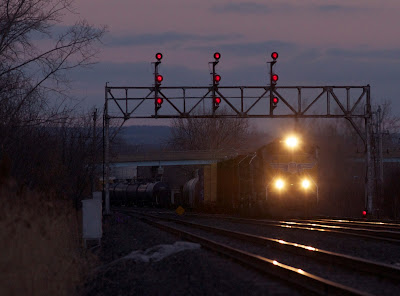
Here's an image from a 2014 trip to Syracuse, NY, expressly to photograph the last stand of the classic searchlight signals on the former NYC main line.  These signals worked into the Conrail era and beyond into the CSX era, and were finally replaced about a year after I made these images with modern color-light signals.  This experience was awesome - this train surprised us, following another westbound, and the sky was in the last stage of dusk.  The image was a tough one.  Last daylight with a camera of that era had a photograph with reds all washed out, muddy shadows and a bland sky.


Back in 2014, my skills weren't enough to even show this image to anyone!  Today, while I am still a long way from being an expert with this, I was able to bring the image to a spot in my mind's eye that reminded me of standing there in the cold, shivering, waiting for one more shot.  Reds were restored, the sky layered up, and color temperature adjusted.  And so here we have Q367, if I recall, the daily Selkirk-to-Chicago manifest train.  Today it is complete with Union Pacific power enroute to home rails.  

And we have an image that is worthy of the memory:  for a moment, it's like being there.

Happy Thanksgiving to you all, and best wishes into the holiday season!

Monday, November 6, 2023

State of Good Repair: Improving Signal Reliability

It is amazing to me that the signals on the Onondaga Cutoff are all approaching 10 years in operation.  The system has worked very well, overall, and I would do it again given the options back then.  The only downside to the current-based detection and the 3.6k Ohm resistors is the rate at which the rails get dirty.  A simple track cleaning ahead of each session essentially guarantees excellent detection, which is the foundation of good signal operations.  

One other intermittent issue which comes up each fall and each spring as the weather changes is the occasional dark head issues with the signals.  In nearly every case, that has turned out to be traced to loose wires in the screw terminals (Digitrax 'TSMK' boards) beneath each signal.  The searchlight heads are comprised of three LEDs in each head, one each for red, yellow, and green.  The wires that connect them to the system are tiny: 'magnet' wire, a superfine insulated 36-gauge copper wire.  


The screw terminals are better with about 24 or 26 gauge wire.  Even when I doubled up the ends of each of the magnet wire by looping it back on itself, some of the heads would work just loose enough with the change of seasons and we'd have a dark head present itself during a session.  I considered soldering under the layout to make a better connection, but the process would have been arduous at best and create a situation where removing a signal if needed would require more soldering or cutting wires.  Yuck!  

A tip from fellow signal modeler Rodney Kantorski turned me on to a tool called a ferrule, essentially a small metal tube with a plastic collar at one end.  The thin wire slides inside, and a special crimper is then used to crimp the metal ferrule tube tightly about the wire, essentially increasing the gauge with no soldering needed.  Thanks, Rodney!

This allows the wire (plus crimped ferrule) to be reinserted into the screw terminal and tightened, which results in a nice robust friction connection.  

So far, every head so equipped has had no issues with the weather change.  Success!  State of good repair projects can really add to the satisfaction in the hobby.  


Wednesday, May 31, 2023

Photos that Stir Memories

One of the fun things about viewing photos in an album is how they can trigger your memory.  Old prints in albums are always good for that, and so are images in a slideshow.  

Today, with digital photography being so common, it's even easier to see a group of photos from time past that take us for a moment to another place and time.  Especially with file sharing and 'the cloud' out there to store and backup files:  you can suddenly be submerged into a different mindset.


Here we have the daily southbound Bessemer & Lake Erie ore train enroute from Conneaut, OH to Pittsburgh where it will be unloaded at the massive J. Edgar Thompson works of US Steel.  This is spring of 2021, a few weeks before Easter and the mountains of western PA still look like winter.  CN by this date has absorbed not just B&LE but also Illinois Central, and some power desk manager decided to have a bunch of CN SD70's assigned to the former B&LE.  I miss the B&LE orange, but I have always enjoyed the look of the older EMD cab and nose design like we see here.  

This was a cold day, but one with little breeze so that the dark soil and roadbed warmed over the course of the day in the bright sun.  I love the old searchlights in this image, the train is imposing and in a hurry, and the big signal bridge and heavy roadbed belies the fact that this line sees just a few trains every 24 hours, almost entirely steel traffic.  The image is bright and dark, color yet black and white, new and old.  

This adventure was part of an 'Old Timers Weekend' trip to Cresson, PA, and it was cherished time with friends that I don't see often enough.  Life is full of opportunities and many conflict - there is rarely time to do everything we would like to do.  Balance is central in those situations, much like it is in the hobby.  

Balance - it determines how long we can stay centered.  

Tuesday, January 19, 2021

The Book! Guide to Signals & Interlockings - now available for presale!

 I am excited to announce the presale for my new book - Guide to Signals & Interlockings , now listed at Kalmbach Media:   https://kalmbachhobbystore.com/product/book/12824


This book is the culmination of 2 years of effort from a variety of contributors and reviewers, as well as the art and editorial team at Kalmbach.  Writing the text and assembling the photos was a major part of evenings and weekends for me through much of the chaos of 2020 and in many ways was a bright silver lining to a difficult year.  Special thanks are due to many:  Eric White, Lisa Schroeder, Hal Miller and Carl Swanson at Kalmbach, Tony Koester, Jerry Dziedzic, Mark Hemphill, Dave Barraza, Joe Relation, Rich Wisneski, Jack Trabachino, Bill Darnaby, Nick Anshant, J. Alex Lang, to name a few.  The greatest thanks are due to my wife Kristen and my kids Susie, Teddy, Pete, who had to deal with a lot of nights of me being distracted and preoccupied!  I am grateful for all the support of each of these people.  

In a small reminder of life going on, it is listed with a shipping date of March 8, 2021.  March 8 is the birthday of my late sister who would have turned 43 this year, and who without question would have been thrilled with this.  She wasn't a train person, by any means, but she was a family person that would have been very excited for her big brother.  It's something worth reflecting on.

It is still surreal to see the cover for sale online, at a site I have admired for years.  I am really pleased at how nicely the Kalmbach team made this look, and am very excited to see it in print!  I am hopeful it will help readers understand railroad signaling more, and that it will inspire beginners and advanced modelers alike to work and include signals where prototypical on their railroads.  It is an exciting time in the hobby and I am grateful for the opportunity to contribute at this level.

~Dave


Tuesday, June 30, 2020

Balance & Priorities

Over the years on this blog we have taken some time to reflect on different parts of the hobby of model railroading, learning about the prototype and balancing that with life in general: family, work, home maintenance, travel. 

With the world changing and reacting to so much these days - the COVID pandemic, racial justice, economic upheaval, and so on - it can feel like so much pressure to stay current, to stay relevant, that we can feel almost lost in the woods.  As part of the book writing process, Jack recently brought over a few prints that made me smile, looking back more than 20 years.


Here's a fantastic shot of Jack's: Conrail train ALSE, exiting Pattenburg Tunnel on Conrail's former Lehigh Valley main line across western New Jersey in October 1998.  This was a daily eastbound manifest freight from Allentown, PA to Selkirk, NY, via New Jersey.  The neat GRS searchlight signals on the original LV signal bridge frames things up.  The green signal on the left tells us that the Lehigh Line Dispatcher has pulled up a route for a westbound train at CP West Portal, some 2 miles west of us.  6497 is a classic Conrail SD40-2, in original factory paint, with new ditch lights.  Jack and I in the later 1990's would call these engines in original Conrail paint 'oldschool' and we each knew exactly what that meant. 

Change is afoot all the time, and it's evident here in the new switch being cut in:  NS was about to purchase more than 60% of Conrail, and wanted to be able to run double-stack and autorack trains here, and will accomplish that by single-tracking the tunnel and centering that main track to use the full height at the crown.  They would make up for the reduced siding length by adding another full siding to the west.  Pattenburg was about to change, forever, despite the oldschool SD40-2 leading ALSE. 


On a frosty morning in 1999, Jack was again trackside at first light, this time at one of his favorite locations in Neshanic, NJ.  Another classic GRS searchlight was there next to the appropriately-named Lehigh Road grade crossing.  Conrail ran MAIL-3, a daily high-priority piggyback train from South Kearny, NJ to St. Louis, MO, west, and after its passage the approach-lit automatic signal 451 shows its red aspect, protecting MAIL-3 from following moves until the train clears the next block.  This signal is gone now, with NS having added another siding west of this location too, which required moving the signals to accommodate the new interlockings. 

My memory of those days is warm and nostalgic.  It brings to mind time past when things seemed more simple.  Perspective is key, of course: they seemed more simple, but that doesn't mean they were.  I was excited but pretty frustrated in 1999: my optimism was still naive and I had trouble reconciling it with the real world.  Still, though, it's important to honor our memories as they are the foundation of who we are now, which is where we begin to be who we will be. 

Now, we look at today.  20 years ago Jack and I were in our early 20's and in many ways had everything in front of us.  Now, I am in my early 40's and have a wonderful wife and three beautiful happy kids.  And those kids regularly join me on the same pieces of railroad I used to visit and that Jack photographed above. 


Here's that siding I mentioned that spelled the end of the 451 signals.  NS 7596, a big GE ES44AC, leads two other GE's on international stack train 22V at CP51, Flemington Jct, NJ, June 20th 2020.  The kids are loving it.  How could I have imagined this in 1999?   It's a wonderful and bewildering reflection.  


Here's a grab of the kids at their favorite spot, Stanton Station, NJ, on June 28th 2020.  Susie is nearly 8, Teddy is 5 and Pete 3.  Excited, optimistic kids that enjoy each other and time together...watching trains with me, learning from their world and each other.  I have a great deal of respect for them and for my wife, who is an incredible mom.  I also am fully engaged in my role as their father, for creating an environment of security and stability, and of accountability, surrounded by love.  It's a ton of work and a heavy load - but a healthy one, and one I am thankful for.  

For this hobby of railroading and model railroading to lead to such powerful and tangible memories is remarkable and more than I'd hoped for in life.  Working for the railroad, writing articles and a book for the hobby press, owning and maintaining an operating layout while happily married and a dad of three is about the biggest blessing I could ask for.  I am so grateful for all if it!  I hope in some way that your hobbies can add to your experience in these ways as well.

So much to be glad for, and so much to look forward to.  We have to see these negative things through, and find a way to stay centered - a spot that is always moving.  

Best wishes for a happy & healthy independence day!

~RGDave
Saturday, May 30, 2020

Signals & Interlockings for your Model Railroad - a book for Kalmbach!

As the wild spring of 2020 continues into summer, with uncertainty still swirling but a growing sense of life going on, I hit a neat milestone for the Onondaga Cutoff that I wanted to share with you and commemorate here on the blog.

This week I finalized and submitted all required components of a new manuscript, my first ever, along with supporting photographs from contributing photographers.  All was loaded onto a flash drive and sent to my editor, Eric White at Kalmbach, who has been a patient and supportive teacher in this.  Thanks Eric, and thanks to all at Kalmbach for working with me to take on this project!


Dropping my first manuscript off at Somerville Post Office
In a world of back-and-forth energy, this is the culmination of 16 months of writing and photography and coordination.  It has been a truly unprecedented 16 months.  A majority of the work was done on my commute to and from work thanks to my Google Chromebook, with other work at night and on weekends to pull it all together.  

I'm excited for the next steps; if all goes well this will be in print in the early spring of 2021.  Good stuff to come!


Wednesday, May 28, 2014

CTC is now....C O M P L E T E

May 28, 2014, will always be remembered as an important date on the Onondaga Cutoff - the date that the CTC was completed on the main line of the railroad!  Thanks to immeasurable assistance from Nick and consulting from Jack, CP282 entered service today and the results are something I am pleased with.  Especially the long-awaited signal bridge for the westbound home signals at CP282:


Appropriately, the signal department installed black bags on the signal heads of the old manual signals so as not to confuse crews approaching CP282.  At a future operating session, a work train will be assembled to come out and remove the signals; until then, we can see past and present at the same time.  Scenery will improve the look of these locations, and now that the signals are installed and working, it's time to start scenery in earnest.


From now on, the Mohawk Dispatcher will be able to see and authorize all movements on main tracks on the entire railroad.  The signals here are all linked to each other and block detection via the computer, just as the rest have been, and so the main track on the entire railroad is now dispatcher controlled.

I must admit this is a milestone that ranks near the top of anything I have ever accomplished in this hobby - it is something I have dreamed of for more than 25 years.  Prototype operation of this railroad requires a working signal system, and now, we have it!

~RGDave


Wednesday, April 23, 2014

Steady Progress

Operations on the Onondaga Cutoff continue to develop, and remain one of my favorite parts of the whole railroad hobby these days.  Interchange between different jobs and railroads is an integral part of that, and so we include not only Conrail jobs but also jobs of the NYS&W, and M&E, in each of our sessions.

Here, NYS&W job SY-1 moves light power through CP280, at the east end of Onondaga Yard.

 Weathering track ahead of ballast installation is a big process and as you can see above, is coming along well.  Much of the progress on a model railroad is just slow, steady persistence, working towards the end goal of a finished layout.  And, in that idea lies one of the more hidden attributes of our hobby:  coaching.  I say this in mind of how the process of building such a creation takes years, if not decades, to complete.  How many hobbies today demand such patience and persistence?   This layout is 'coaching' me to be more patient, to relax and enjoy the process.  For example, due to supplier issues, I am still awaiting the delivery of the final signal bridge, which in turn delays the process of installing the ones I have on hand.  It's frustrating, but on the other hand, there's lots to do to keep progress moving.

One bridge that we do have on hand now is the bridge to support the intermediate signals at MP 278.  Here's that bridge, ready for installation, complete with number plates I built using decals with the correct Conrail font:

I love how these turned out; Tim at Integrated Signal Systems did a masterful job with the soldering and included details that really make the bridge a special piece:  ladders, NYC-style targets, and different finials (the top cap on the masts) per the prototype.  This bridge will be lit the same day as all the remaining signals.

Slow, steady progress is how you get to the destination - and also how I enjoy the process.

~RGDave

Thursday, January 30, 2014

Final Preparations

Yesterday's action on the model railroad:

The signal crews on the Onondaga Cutoff have been busy doing the preparation work for the final cut-in on the territory, which will be CP-282, the interlocking controlling the main line at the west end of Onondaga Yard.  The signal bridges themselves are under construction and have yet to be delivered, but the dwarf signals and masts are on-site and the crews are working to install all the boards and connections underground ahead of the cut-in.

Foreman Anshant is seen here with his crew on the South Runner, waiting for foul time on Track 1 to finalize an insulated joint.

Once the new signals are in place, the manual signals pictured here will be removed.  Local railfans are doing what they can to document the last of these, as they will all be gone here within the next few months.

And - in the same light - a small group of guys went to the prototype Chicago Line in Syracuse, NY, a few weeks back to document the last of the former NYC signals before they, too, are replaced this year.  Here's my image of CSX train Q384 about to knock down a medium approach aspect at CP-286 in East Syracuse, NY, as the snow falls heavily around us, with another eastbound train lined up on Track 2:


The remaining photos will be in my flickr account, some of which you can see now at this location.   More are added as time permits.  Stay tuned for photos of the final cut-in later this winter!

~RGDave

Monday, August 26, 2013

CP 280 is Online!


As hoped, the cut-in for CP 280 went smoothly, and despite there being 15 heads and 5 turnout combinations to program and wire up, all of those tasks were completed in one evening.  Below is a photo of the eastbound home signals at CP 280, including those on the bridge for the main tracks as well as dwarf signals beyond, protecting the North and South Running Tracks.


The Local Control Panel was installed in the several days after the cut-in.  As of this week, the interlocking is complete except for scenery.  Exciting progress!


We are aiming to make more progress in the signal department over the next month, before the next operating session.  Much of the hardware and signals are on-hand to complete the remaining work; all that remains to be delivered are the final 3 signal bridges for CP 282 and the automatic signals in Camillus.  Integrated Signal Systems will be delivering those to me within the next few months as well.

Step by step, we are getting there!

~RGDave

Tuesday, August 20, 2013

Major Signal Progress


The signal gangs have been working steadily on the Onondaga Cutoff, generally from east to west, installing signals as they arrive from the manufacturer.  The latest batch to be installed include all signals protecting CP280, adjacent to the Onondaga Engine Terminal.  Here's a view of the bridge protecting CP280 eastbound, modeled after the westbound home signals at CP286 in East Syracuse, NY:


And, the unique bracket mast design protecting CP 280 westbound, with a backdrop of the engine terminal:


As we had discussed several months ago, this signal is modeled after the prototype westbound home signal at CP293 in Solvay, NY.  The Track 2 signals are mounted higher than the Track 1 signals, allowing trains running west on 2 to more easily see their aspects over a train on Track 1 due to the curve on the approach. 

All of these signals, along with the dwarf signals protecting moves onto and off of the North and South Runners and East Lead, will be activated this week.  If all goes well, by the end of the week, CP280 will be fully on-line and ready for service at the next operating session!

So, despite a busy summer schedule and a happy, excited baby daughter, we are still able to keep pushing forward on the 'O-C.'  Stay tuned, more to come!

~RGDave

Friday, July 12, 2013

Little Here, Little There

The dog days of summer have arrived early here in northwestern NJ; long, hot & humid days with the occasional thunderstorm.  Actually, it's been one of the wettest summers on record so far this year.  Dodging showers offers some time to be in the basement working on the railroad, so here's a July update with some progress.

The first is a sneak peak at a builder's photo of the next signal on its way to the Onondaga Cutoff - the bracket mast that will guard the eastern entrance to CP280.  This is another of the magnificent custom signals that are being built and supplied by Integrated Signal Systems.  The offset heads are a unique feature required here due to the curve on the approach - the higher heads for Track 2 will allow crews of trains on Track 2 to view their aspects over the top of a train passing on Track 1 (Photo credit Tim Maslyn):


This signal was modeled after the prototype installation at CP293 on the Chicago Line, with the difference being that CP280 is a yard entrance and therefore needs 3 heads to display the proper diverging aspects.  Compare below (Photo credit Nick Anshant):


As always, while waiting for new signals to arrive and for work-nights to be scheduled, I am working on other projects to fill time and keep the progress moving.  Currently, another B36-7 project is occupying the work bench, and is seen here ready for painting.  Creating an HO scale B36-7 is a chore, since there are none available in plastic.  The best starting location is the Atlas B30-7, as most of the details are correct.  I needed to rearrange the air intakes at the radiator section, modify several doors, replace the cab, remove the nose headlight mount, and add numerous details including an anticlimber, cab-signal box, several antennae, etc. 

And, most importantly, Susie has turned one!  It is truly hard to believe that she was born more than a year ago already.  She continues to be a happy, healthy little girl, and her presence has brightened my world.  Happy Birthday, Susie! 


Enjoy the long, peaceful evenings on these summer days!  Thanks for reading, please check back soon for more updates as the projects continue!

~RGDave

Friday, May 24, 2013

The Next Cut-In

Tuesday of this week, thanks again to Nick and this time, Jack as well, we have another major step forward on the Onondaga Cutoff - the second of 6 interlockings is cut-in and fully computer controlled!  Tuesday, May 21, just before midnight, manual signals were removed from service and new, fully functional interlocking signals were placed in service at CP274, the easternmost interlocking on the railroad.

Here, we see the eastbound home signals for CP274, looking east with the Island East Lead coming in from the left, then Track 1, then Track 2 to the right.   The LEDs are nice and bright, and when seen in person, they appear considerably more red than these photos would suggest.  The brightness will be important, since as you can see, this is the lower level and will be covered by scenery above in the future.  Crews will be able to view their trains on the lower level from the side at this spot. 

Next, we move to the westbound home signals for CP274, all of which are visible in this image looking west out of staging.  Tracks here are S5 in the immediate foreground to the left, then S4, S3, S2, and finally S1 all the way to the far right.  

Single-head dwarfs guard the entrances to CP274 off S5, S4, and S3, due to the fact that the best aspect a crew can get out of staging is a slow clear (green) from these tracks.  Since all three of those tracks must pass through the #5 switch, which is a diverging move, that is the best aspect.

However, since on S2 and S1 trains do not necessarily need to diverge, a better signal aspect can be displayed, which requires another head on the dwarf signals.  Green over Green allows for a 'clear' aspect.  Seen here, S2 west is displaying green over flashing red, 'Medium Clear' for a westbound move from S2 to Track 1 west.

While we were able to get CP274 cut in in just one night, just like CP277, this belies the amount of work that was completed - CP274 is significantly larger than CP277, and so required much more work with both signals and switches.  While I worked to wire signals and Nick entered data into the CATS software and JMRI in the computer, Jack worked on the other side simultaneously, and wired switches to the SE8c.  This extra effort was absolutely essential to finish the work in one night.

As you can see, another major step forward was to receive the final LCP's from the print shop - now that we are doing cut-ins for the real interlockings and signals, it is time to begin to install the LCPs to compliment that effort!  The only work remaining for me to do is to finish up the wiring in the local control panel (LCP) for CP274 as well as the first cut-in, CP277.  That said, Nick's design worked perfectly for the panels!  A blog post on this process is coming soon, but I wanted to show you what they look like - I'm very happy with how these are turning out.

Summer is slow to arrive this year in New Jersey, but progress on the Onondaga Cutoff is benefiting from that!

~RGDave

Friday, March 22, 2013

Major Step Forward

I'm happy to provide some of the most significant news to date regarding the Onondaga Cutoff:  on Wednesday, March 20, the home signals at CP277 were cut in, and are now fully under computerized dispatcher control.  Here's a telephoto view of the new eastbound home signals:


And, enjoy this video of the first test run, an eastbound manifest freight, knocking down the eastbound 'clear' aspect on Track 2:


These are the first of many beautiful, custom signals I have ordered from Integrated Signal Systems in Florida.  ISS builds signals to your specifications, and I have found they are much more to scale than others on the market.  CP277 is the first of 6 interlockings and 3 intermediate signal locations to be cut in.  As the budget progresses and allows more signals to arrive, more cut-ins will follow.  It's a long term project - I am working to have the full railroad under computerized control, with manual options, by the end of 2013.

This project would simply not be possible if not for the help and guidance of those assisting me.  Like Rick helped so much with bench work 4 and 5 years ago, Alex, Jack, and Nick have been instrumental in operation and signal system design, and Nick deserves special mention for signals, as he has stepped in with this new layer of signal construction and installation.  There is plenty of work to come, and their help and enthusiasm is invaluable.

In a society that increasingly is obsessed with immediate satisfaction and quick rewards, I believe there is something to be said for grand visions and for the continual progress required to accomplish all that the vision defines.  Smaller steps over time perhaps call back to 'old hobbies' or a more simple society, but there is something natural about that:  Long-term projects involving numerous people working together over years, like the construction of the Onondaga Cutoff or that of a real railroad, hold a special energy.  Further, operating a railroad builds even more upon that same chord.  There is a sense of community that is only developed when people come together, working towards a common goal in construction, or in an efficient operation. In reflection, that energy is one of many reasons why I have always loved the railroad.  It's a journey.

Thanks for joining me on the journey!
~RGDave

Monday, February 25, 2013

Block Detection - Fully On-Line!

In another major milestone, this one thanks largely to the help of Nick, I can announce that all 33 detected blocks on the Onondaga Cutoff are fully linked to the computer and the dispatcher's screen.  While work remains to equip each car on the railroad with the resistive wheelsets necessary for the detection to trip, the system itself is where it needs to be.  Take a look!


Nick built all the signals in to the CATS software, which runs with JMRI to control the signals in a CTC fashion.  The software is now essentially ready to be linked to the signals themselves, but first we need to get the interlockings converted from their current analog control boards to digital controllers, which are stationary DCC decoders designed to control 8 turnouts or pairs of turnouts each.  The interlockings are the next major project, but for now, it's fun to see trains 'routed' (green lines) across the railroad on the screen, and more fun to watch the track occupation lights (TOL's, the red lines) flash in as the system detects the train on the track. 

Exciting progress!

~RGDave

Thursday, April 19, 2012

The Edge of a Dream

Ever since I was young, I have been fascinated by railroad signal systems. Of course, the trains came first, and those remain the star attraction, but the idea that an operator or dispatcher could give trains permission to move over track by controlling signals and switches from a remote location always captured my attention. So, you can imagine the first time I witnessed a working signal system on a model railroad – WOW!

A sign of things to come...medium clear!

Therefore, one of my life-long modeling goals has been to have a working, dispatcher-controlled signal system on my model railroad. For me, that means scale, functional, NYC-style searchlight signals.  Exactly like the one above, manufactured by Integrated Signal Systems.  But there were always questions: first, how does that work? Second, once that works, it needs a full-time dispatcher. How then can I have the signals work as an ‘automatic’ signal system for the times when I am running the trains myself?

These two short questions have taken more than a year to answer. And we’re still working on it. It has been a real learning process to this point trying to figure out how all these goals can be accomplished; many thanks go to the guys that have spent so much time on this so far - Nick, and Alex. Thanks also go to Jack, Mark, and Scott, all of whom have made valuable suggestions in the design.  Model railroad signaling is complicated and expensive, especially on a big layout like the Onondaga Cutoff. The signal systems themselves, especially if they are to be dispatcher-controlled, boil down to systems that must work hand-in-hand with the control system.

Digitrax users have the benefit of the fact that Digitrax has a fully functional signal system to choose from that simply couples in to the Loconet cab bus. For us NCE users, we pay for the easier interface that NCE provides by having to use other’s signal components, since NCE does not yet have a working signal control board. In fact, while I am depending on NCE for block detection and layout control, I am depending on Digitrax for future turnout control and for signal control.

The link between the two systems is provided by the Java Model Railroad Interface, or JMRI. JMRI is an open software package available online for no charge, supported by a group of modelers that use it daily. This software allows for computer control of the DCC system and model railroad. It allows a computer interface to program decoders, speed tables, consists, effects, and also provides a pathway to link NCE to Digitrax via a USB cable so that my NCE layout can use the full Digitrax signal system. Plenty to come on this amazing project!