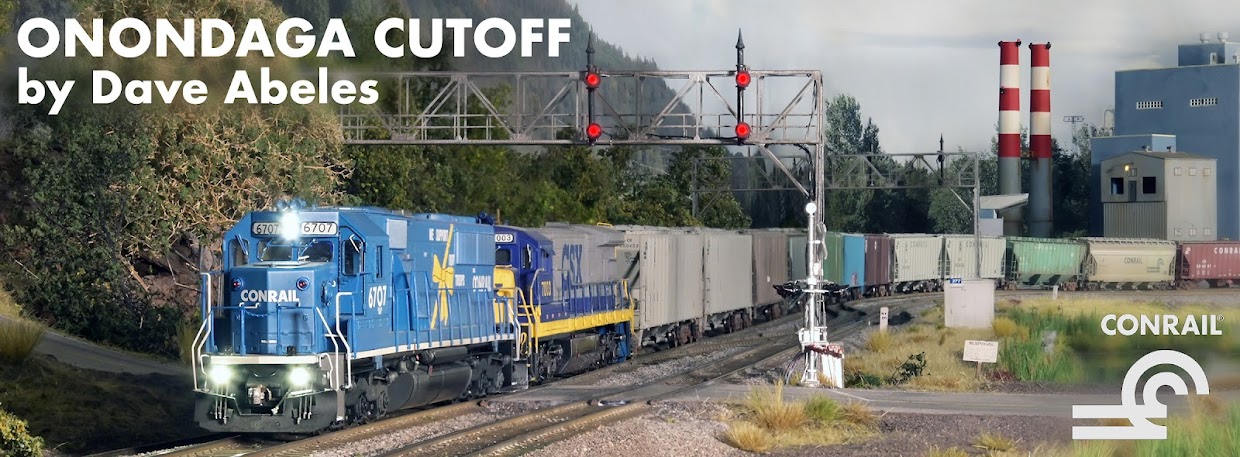
March 31, 1976, was a foggy day full of drizzle. Spring was slow to come that year and it was a gloomy few days as April approached. This was to be no normal March-to-April change, though, not for railroading in the northeastern United States of America.
Fifty years ago, railroaders and their families went to bed knowing that it was hard to tell what was coming in the morning. Like the foggy sky, the future was unclear and hard to see. The largest change in the history of railroading in that region was about to become reality for them. April 1 would be the start of Conrail's operations, bringing federal help and a bold new goal into sharp focus.
 |
| Bob Camp, Detroit, Mort Walton photo |
As amateur historians, many of us who love railroading reflect on the past to find some solace in the present. Change is more constant than may wish it to be, and having an understanding of the past helps us to build a present and future that incorporates the better changes as we can manage it. But there is no way to tell how it is going to turn out. There is no crystal ball, really, no guarantee it will work better than it does today. We have to credit the fallen flags, the companies that tried their best to survive an era that had turned against them. They were forced to give up. And when that happens, it feels like maybe we should give up, too.
But like Conrail, we have to try. It is an obligation of every person to try. In order to push our families and our community forward, we must take action. Gloom and the fog in the future is no reason to sit and wait. To create a better today and tomorrow, you cannot wait for life to come to you. Action, accountability, compassion, and perseverance are indispensable for improving our future.
And so, let's be like Conrail was, on Conrail's 50th birthday. Let's take a chance, even if on a wild idea, to make things better. Maybe tomorrow we can do it again!






 And a going-away shot of the same train at the bridge:
 It's fun watch the train cross the bridge, with shadows from the truss moving over the rolling stock and locomotives!

 Interlockings take a long while to install, because it needs to be right the first time, and it involves everything at once: both tracks, sidings, switch machines, and eventually, signals. Everything, including predrilled holes for switch machines, has to be located exactly before any piece of track can be permanently fixed in place. I like this view of the new infrastructure:
 A recent article in Model Railroader was written by a modeler who never used commercial flex track or switches, preferring to have the realism offered by hand-laying. Recently he needed to finish a new addition to his layout quickly and had to use commercial products, and wrote an article on how he made them work with his design. One idea of his that I used over the weekend was to modify commercial switches to flow better with my design at the east end of CP 282 - this is a Shinohara (Walthers) #8 frog, left-hand switch. I cut the long ties on the far side of the frog with a razor saw, used a utility knife to remove the tie spacers beneath the rails, and then gently and patiently curved the main route and diverging route to match the adjacent curves. I am very happy with the results - subtle, but crucial to the future alignment.
 On the far side of CP 282, along what will be Onondaga Yard, the mainline makes a sweeping curve. I use masking tape, layered and staggered by several inches on each end to 'step up' to the full superelevation gradually at both ends of the curve. Pictured here, Track 1 has the tape installed, while Track 2 to the left is waiting for tape.
 So, the interlocking at CP 282 is now in place, though not yet operational. Here is the overview for an eastbound train. The North Runner for Onondaga Yard comes off on the left in this view, and the connector to the M&E is on the right in the middle distance:
 As always, more to come - each rainy weekend allows some time to make some progress!