Friday, November 15, 2013

A Fresh Look

Model railroading is a life-long hobby for those that choose to make it so.  I would argue that, compared to other hobbies, model railroading offers enjoyment at various levels, which is one angle that makes this hobby so great.  When you are a beginner, just starting out, the hobby is entertaining.  As you grow in the hobby, your skills and vision become more refined, and you can take it as far as you want to take it.

One example of that is my 3279.  This is a classic engine that I purchased in 1989, manufactured by Athearn Inc. in Compton, California.  This was part of their regular lineup and was painted at the factory in the Conrail livery.   Even at that time, I was interested in detailing locomotives and so I added several parts to the model to more closely represent the 'real' Conrail 3279, formerly a Reading Company GP40-2.  This meant that I needed to change the size of the fuel tank, add a cab-signal control box, snowplow, lift bars, and MU hoses, paint & decal the number boards and handrails, and weather the engine.

As my skills improved over the years, the 3279 started to look shabby in comparison to models I had finished more recently.  Other parts became available.  My research showed me ways in which I could further improve the model.  And finally, the conversion to DCC several years ago presented a great opportunity to take another hard look at the old 3279, and bring it up to modern standards.  Here's the result:


Without much doubt, this is the best this model has ever appeared.  Details make the model, and the correct fuel tank, the angled 'rain gutter' on the roof, smaller decals on the frame and nose lettering, and additional weathering all combine to create a more plausible model.

This hobby will grow with you.  There remains much to learn, of course; still, it is satisfying to see that, with some work, a model that stood out as being an early effort can be upgraded to fit better with the rest of the fleet.

~RGDave

Tuesday, November 5, 2013

Car-Forwarding & Freight Movement

After the Train Plan, the other central piece of paperwork in any operating session on the Onondaga Cutoff is the car-forwarding plan, as designed by Jack T. and Rich W.  Based on my research and layout space, I had come up with several industries loosely based on prototype facilities on the Chicago Line.  While not exact replicas, these industries are built to approximate the feel of some of the online industries that Conrail (and Syracuse-area shortlines) served.  This worked as we got sessions started two years ago.

However, yard traffic naturally ebbs and flows and due to the yard’s capacity of approximately 75 cars, and we realized quickly that things can get rather unmanageable for the Yardmaster as there was no set plan that allowed operators to plan ahead.  Nor was there any consistency to when the setouts and pickups were made.  Jack and Rich therefore took the loose plan a step further, devising a full interchange plan to accommodate where these cars would have come from and how they would be forwarded back. 

This plan has become the network behind the operation, assigning each and every move through Onondaga Yard a specific set of orders that are incorporated into switch lists and interchange manifests.  All trains that work the yard are on this sheet, as well as every industry, and the time the train arrives and leaves.  In the matrix are the car counts and types, helping operators keep track of their moves.  It appears complicated, and it was to create; however, operating with it is actually much simpler than it looks, and the entire operation is smoother now.

Now, it’s the key to the whole operation, and we’re learning more about it with each session!

Finally, an update for you on the signal progress:  the final 3 signal bridges are under construction this month, and should arrive before the end of 2013.  That will complete my order with Integrated Signal Systems.  With all the remaining hardware on hand, the completion of the signal system is just a few months away, and a dream of a fully-signaled, dispatcher-controlled mainline will be a reality.  These are exciting times!

~RGDave

Monday, October 14, 2013

The PLAN

Realistic operation on a model railroad requires more than just running trains on a nice-looking layout with realistic locomotives and cars. While those parts are components, and certainly add to the experience, the operation aspect is based on a plan. Since real railroads move freight and people according to a plan, we need a plan to model that operation.

Just as in reality, the plan is the basis for the trains that run in any given session. Therefore, here is our master plan - the master schedule that has been created to best represent a full 24-hour period of traffic that would have run on the Onondaga Cutoff (i.e., traffic that did not work Dewitt Yard), in 1994.

There's a lot that went into this - a base list of trains that I provided, hours of research by Jack using Conrail schedules from 1993, 1994, and 1996 to determine what time those trains would have been scheduled through my railroad, and - perhaps most importantly - experience running trains on the layout.

This is the key to all the other paperwork we use. Next time, we'll take a look at the other vital piece - the car-forwarding system.

In the mean time, enjoy the autumn! Lots of projects coming up soon on the Onondaga Cutoff.

~RGDave

Friday, September 20, 2013

On Operating Sessions...

A photo for you all:  It’s 4:25 a.m. on September 14, 1994, well before dawn, at CP 277 on Conrail’s Onondaga Cutoff.  The Mohawk Dispatcher has lined TV-8W, an eastbound stack train from Chicago to Worchester, Massachusetts, on Track 2 around WADE-30 (stopped at left) and SEEL, whose headlight is visible in the distance.  TV-8W's approaching headlight illuminates the signal bridge for just a few seconds.


One thing that has surprised me over the course of the development of the Onondaga Cutoff is how much satisfaction I take from hosting an operating session.  In the past, I’ve always enjoyed the building part of the hobby.  Operations was something that came later, largely thanks to my interest in prototype operations, and the steady influence of Jack, my longtime friend and partner in all things railroad.  During the design phase of this layout, it was apparent that this project would be much larger than any I had constructed before, and therefore could be fun with multiple operators.  Still, I generally imagined running trains myself more than I thought about any organized operations.  That changed in a hurry after the tracks were in place and operational!   It was quickly apparent that some sort of organization was needed to avoid chaos.  Paperwork was part of the operation from the beginning, but has taken on a critical role for each session now.  Thanks to the fact that the track design is as prototypical as the space would allow, operations really came very naturally to the layout. 

Over the next few blog entries, I plan to present some of the paperwork we use to make it all happen.  Once a month, the Onondaga Cutoff comes to life, and for a few hours, it feels like 1994 all over again.

~RGDave

Monday, August 26, 2013

CP 280 is Online!


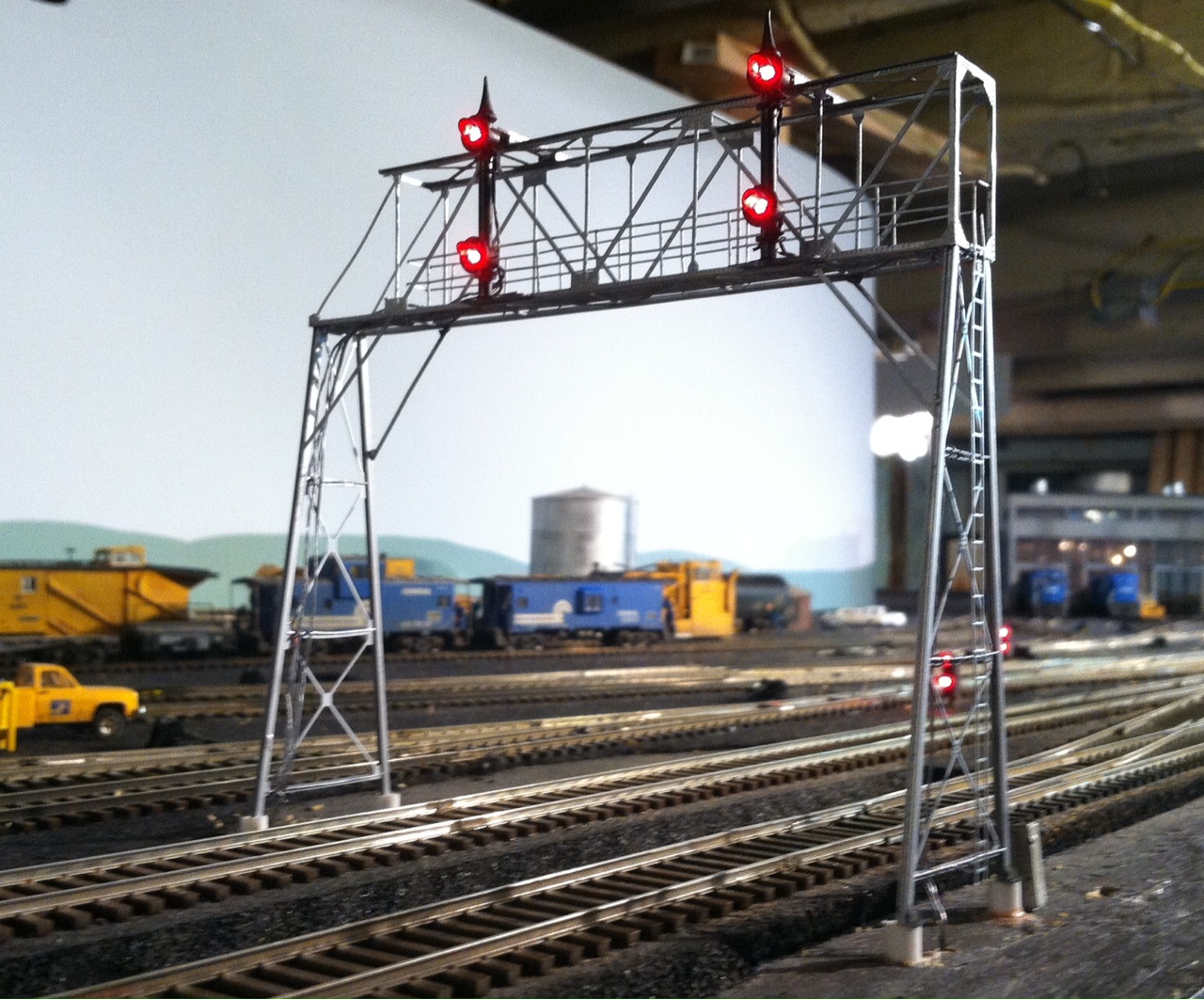
As hoped, the cut-in for CP 280 went smoothly, and despite there being 15 heads and 5 turnout combinations to program and wire up, all of those tasks were completed in one evening.  Below is a photo of the eastbound home signals at CP 280, including those on the bridge for the main tracks as well as dwarf signals beyond, protecting the North and South Running Tracks.


The Local Control Panel was installed in the several days after the cut-in.  As of this week, the interlocking is complete except for scenery.  Exciting progress!


We are aiming to make more progress in the signal department over the next month, before the next operating session.  Much of the hardware and signals are on-hand to complete the remaining work; all that remains to be delivered are the final 3 signal bridges for CP 282 and the automatic signals in Camillus.  Integrated Signal Systems will be delivering those to me within the next few months as well.

Step by step, we are getting there!

~RGDave

Tuesday, August 20, 2013

Major Signal Progress


The signal gangs have been working steadily on the Onondaga Cutoff, generally from east to west, installing signals as they arrive from the manufacturer.  The latest batch to be installed include all signals protecting CP280, adjacent to the Onondaga Engine Terminal.  Here's a view of the bridge protecting CP280 eastbound, modeled after the westbound home signals at CP286 in East Syracuse, NY:


And, the unique bracket mast design protecting CP 280 westbound, with a backdrop of the engine terminal:


As we had discussed several months ago, this signal is modeled after the prototype westbound home signal at CP293 in Solvay, NY.  The Track 2 signals are mounted higher than the Track 1 signals, allowing trains running west on 2 to more easily see their aspects over a train on Track 1 due to the curve on the approach. 

All of these signals, along with the dwarf signals protecting moves onto and off of the North and South Runners and East Lead, will be activated this week.  If all goes well, by the end of the week, CP280 will be fully on-line and ready for service at the next operating session!

So, despite a busy summer schedule and a happy, excited baby daughter, we are still able to keep pushing forward on the 'O-C.'  Stay tuned, more to come!

~RGDave

Wednesday, August 7, 2013

Ready to Go!

The remaining signals needed for CP280 are now in the mail, which is exciting news!  The current plan is to cut-in CP280 later this month.  As we saw last time, the time spent waiting for those signals to arrive was used to work on my latest locomotive project.  I'm happy to be able to present the latest addition to the fleet!  After a set of decals, dullcoat, and some weathering, the 5050 is finally ready to go!  Here's a few views of the 3rd B36-7 to join the roster.  First, a 3/4 front, cab-height angle:


 And, a broadside:


This unit will soon be MU'ed with several others pulling intermodal trains around the railroad, with occasional appearances on manifest freights as well. 

Thanks for looking!  Next time, perhaps I'll have a few new signal shots for you!

~RGDave