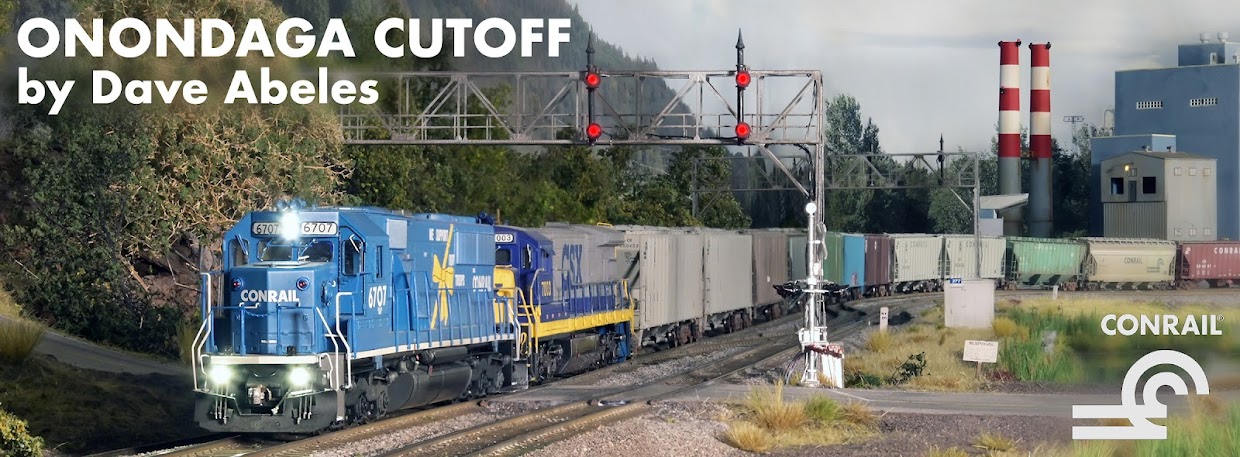
Friday, May 28, 2021

Progress, Here & There

Progress on the layout varies a bit by season.  Looking over the 12 years or so of entries here, in most cases there is a load of progress on the Onondaga Cutoff in the winter and spring which tails off a bit once we get to the warmer months.  Part of this is more outdoor activities and household maintenance tasks, and more of it is using free time for trips or helping on other's layouts, too.  It's all a welcome part of the hobby. 

Some of those trips are just local jaunts with the kids.  Kristen and Susie had a weekend Girl Scout camporee last weekend, and so the boys and I had a weekend to spend time together.  Teddy calls that "boy time" and looks forward to it, which warms my heart!  Pete & Teddy wanted to watch trains, see some new things, and explore together, and so we did just that.


Along our local mainline, the NS Lehigh Line across central NJ, we did some hiking along the rivers and found a new-to-us through truss bridge.  Teddy still loves bridges of all types and especially railroad bridges.  They were amazed!  

During the evenings, I made time to finish a few projects that had been hanging around the workbench.  Months ago I finally purchased a vacuum car for the layout after finding a good deal on eBay for one.  It was the Lux model from Germany but works seamlessly with my DCC system.  But, I thought the bold German lettering was a bit much.  So it got a coat of paint, replacement couplers, and new lettering for a plausible piece of Conrail maintenance equipment.  Here it is, awaiting final weathering, after which it will join my CMX track cleaner car in the setup night maintenance train.


And, some of the long term collecting of Conrail covered hoppers is beginning to pay off.  Thanks to amazing weathering by Lenny Harlos, we soon will have a unit grain train for the Onondaga Cutoff, which fills yet another gap in our operating plan.  Here's a sneak peak of work so far.


As spring opens up in to summer, and as pandemic restrictions seem to finally be waning, it's exciting to look forward to so much that we used to take as guaranteed.  Operating sessions, family gatherings and road trips - all these things are coming back soon and it's an exciting time.  Best wishes to you on this Memorial Day weekend, may we keep in mind those that have given their life in service to our community and our nation.  

And may the best still be yet to come!
~Dave

Thursday, May 13, 2021

Upgrading the Tower at CP 282

 A continuing vision for the Onondaga Cutoff is to 'Let Experts Be Experts.'   We've discussed that before, and it is manifested in different ways.  Skilled hands helped with benchwork.  Trusted advice from Model Railroader and Railroad Model Craftsman guided track installation and wiring.  Computer and IT experts helped me with networking.  Signal professionals did the signal design and guided the installation.  Transportation Planning professionals designed the car-forwarding and locomotive distribution systems, and design each operating session.  The list goes on, but it is clear that the total is much greater than the sum of the parts.

Recently, I had been searching for a suitable permanent model at CP 282 to represent an old NYC tower, repurposed as an office.  My vision was to model the tower that once stood at SJ interlocking, which became CP 293 under Conrail's tenure.  Al Tillotson, a talented modeler and regular operator on the OC, had contributed a foam-core and photo-printed stand-in that was suitable for its purpose for the last several years.  However, my goal was to model the brick and mortar construction from the 1930's as NYC upgraded its route through Syracuse.  


SJ was a critical interlocking that included not just the Water Level Route mainline but also the old Auburn Main, the Freight Bypass to the north, and the Lackawanna Oswego main line and interchange - plenty to keep the operator busy.   By the late 1950's though, NYC was installing new Centralized Traffic Control on its main routes, which allowed interlockings to be remote controlled from many miles away.  This made the tower operator and manual interlocking redundant.  The machinery was removed in the late 50's but the maintenance crews continued to use the tower as an office for decades to follow.  By the mid-90's, though, the end came and the structure was demolished.  

I worked with Perry Squier, a local modeler and expert scratch builder, to move forward.  Perry offered to build the tower if I could find plans.  Through the internet I came in contact with a former Conrail employee that - believe it or not - rescued the actual blueprints for this tower from a dumpster.  Amazed, I reported back to Perry who was surprised and pleased that we'd located the actual plans.  I made copies and Perry got to work.  


Perry asked that I do any interior detailing, which I did during a test-fit of the structure.  I also added lighting before returning the project for completion.  Perry delivered the final structure after several months of work, and I installed it on the layout - what an improvement!  

This adds a tremendous amount of NYC heritage and flavor to a scene that was already nearly complete.  The old tower was removed, and will be headed for my boy's layout in the attic, thanks to Al's generosity.  The new tower does an amazing job at night!

Another example of collaboration that turns out for the best: asking experts to help has made this layout greater than it could be if I were doing it myself. 

Wednesday, April 28, 2021

A Walking Tour of the Onondaga Cutoff

With recent requests for a video overview of the Onondaga Cutoff, I am excited to present a new YouTube channel and a few videos for your enjoyment!

I recorded a walking tour for viewers and have posted it on YouTube at https://www.youtube.com/watch?v=2cIHKGQF1wM  


The railroad is always a work in progress, of course, but this is a good snapshot as of Spring of 2021.  Enjoy!


Monday, April 19, 2021

Sweeping Vistas

 Now and again, it's nice to make a few images of the layout and of some of the longer and more sweeping views that are possible with a basement-sized layout and photo backdrops.  Views are even more satisfying when you consider how much time and effort has been spend behind the scenes in the last few months with major construction projects!  Here's a few recent efforts:

Amtrak 276 meeting SEIN at CP 280, Onondaga NY

BRSE at CP 282, Onondaga NY

By combining high F-stops for depth of field with Helicon photo-stacking software, you can really create some memorable images around the layout.  Looking at photos like these takes me back in time to warm days along the tracks on the prototype, waiting to see what the railroad would run past me.  It's a soothing experience to let the mind wander using the layout as the medium!


Wednesday, March 31, 2021

The Final Step: New Island Local Control Panel - Ready to Go!

 After a big push in the last few weeks, it's now time to report that the installation of 'deep' staging is complete on the Onondaga Cutoff!   Last time we finished up the trackwork installation, which has since been wired into the system.  The final step was to replace the Island local control panel (LCP) with a new one to reflect the changes.  

Thanks go to Nick Anshant on this step, as he is always willing to use his experience on the prototype to help make the Onondaga Cutoff better. We went back and forth to settle on the new layout of the lines and also the new names - these tracks will be named the 'Old Auburn Main' along with a pair of running tracks, reflecting Conrail practice in the Solvay, NY area on the prototype.


Nick had done standard artwork to reflect Conrail practice in the signal bungalows in the field and had the artwork from the previous panel that he was able to modify to reflect the new trackage and switches.  One the art was set, I sent it off to a local sign shop who printed it on 1/4" thick PVC.  I chose plastic here instead of aluminum because the mounting area on the masonite hardboard has a slight curve.  A side benefit of PVC is that it is easy to work with.  I used a 1/8" allen wrench screwdriver as a hole punch by setting the new panel on flat wood on the workbench, and tapping the back of the screwdriver with a small hammer.  This allows the holes to be drilled cleanly and helps prevent the drill bit from wandering.  Here's new panel ready for light installation.


It is nice to do this work at the workbench, too, before trying to mount the panel to the layout.  Now it is time to carry it to the location of the install - much of the work this time around is to simply move the controls from the old panel to the new one, before installing the remaining new hardware.  


Thankfully, the old panel was set with screws, and had enough extra length in the wiring to allow it to hang forward for the work.  I moved the pushbuttons and LEDs over in number order, pair by pair.  It was an arduous and slow task but that was to be expected for a project like this.  However, I did not like putting all the tension on those soldered joints.  So, it was time to build a temporary work shelf.

Using some of the leftover brackets from the benchwork construction for the deep staging and some C-clamps, I set two supports attached to the masonite and set some 1" foam insulation left over from a recent scenery effort across those to act as a work shelf.  This allowed the rest of the cutover to go smoothly, along with the install of the new double-pole, double-throw (DPDT) toggles for switch control and the new LED indicator lights for the new tracks.

By the end, I was more than ready to clean up the area, put the tools away, and turn on the final installation for testing.  I ran engines up and down each route, checking to make sure all was properly indicated and powered.  I tested the on-off toggle as well and sure enough, it checked out!  

In summary, this was a long-awaited project that in some ways I was dreading.  It was tight, and operationally more tight than anything so far on this layout.  But it came together thanks to working with the team - modifying the plan and the construction by discussing with others, having others help to set components in place, and finally making the decision to dive in and do it at the tail end of this pandemic before life gets hectic once again.  

Now comes the exciting part - assembling the unit trains to occupy the track, and adapting our operating plan to fit the new traffic!   Stay tuned as we head into an exciting spring on the Onondaga Cutoff.


Thursday, March 25, 2021

The Book Has Landed!!


It is with great pleasure that I can announce the release of my first book, Guide to Signals and Interlockings, which is in print and available for sale!   

In the largest news to date on the Onondaga Cutoff, the layout is the central feature of this new publication by the editors of Model Railroader magazine.  It is the culmination of the journey that the signals on the Onondaga Cutoff have been, and contains information on the process so that the reader can understand how that works.  


Many nights and weekends went into it, and now it's available from booksellers, hobby shops, online, and also directly from the publisher at https://kalmbachhobbystore.com/product/book/12824

In the 'Is this really happening' department, a friend sent me a screen shot showing the book having reached '#1 Best Seller' status on Amazon.   Amazing!  


Thank you for all the support!  I hope readers enjoy it and learn more about railroads and signaling as a result.  In a hobby and in a world where there is always more to learn, it is a humbling and exciting process to go through the journey of creating something like this.  I am grateful for the opportunity and excited for the future!


Monday, March 22, 2021

Deep Staging - Completing the Trackwork

The construction of  your layout can tell you a lot about yourself.

Take this Onondaga Cutoff 'deep staging' project, for example.  The idea started organically, without a clear path forward at first, but always in line with the vision of an exceptional operating experience.  Once the idea started it was widely shared with others I trust to vet its weaknesses, and to ensure it was well thought out.  It's measured, constructed and installed to stand the test of time and to provide error-free operation.  And, once it started, the project hasn't stopped much for other modeling endeavors except for glue to cure or paint to dry.  The progress is really settling in, a nice smooth grade down from the right, around the curve towards the new lowest level.


Taking a step back I am quite sure that most things in my life that I can control follow all those same adages.  Most things I am involved in did not come from a pre-planned set of goals, but they almost all serve a central vision for life.  I have learned in my 44-1/3 years so far that most things in my world are better with the influence of others that are experts in their way, or that know me well enough to give me honest feedback on how I might improve things.  Once I decide to build something, I want to do it once, and do it right: taking hours and hours to create something that doesn't work well or to make a repair that can't hold does not suit me.   And once I decide to jump in, it's with both feet - unfinished projects cloud the mind and the schedule, and make the satisfaction of moving on nearly impossible.  

None of that, of course, is to say that it is easy, or even that I take my own advice all the time.  Nope, I am routinely surprised (and sometimes frustrated) by the things I do, but I do hope to learn from each experience and carry that going forward.  Life isn't lived on a shelf or on paper; it's lived by doing.  The key in my view is to spend enough time planning and considering and sharing any idea first so that the act of doing is more effective, more present, and less prone to the erosion that time will inevitably bring to us all.  

Some thoughts for you all on a Monday night as I reflect on progress so far on this deep staging installation.

In the past few nights, we cut in the switch to the existing track.


This process begins by selecting a location for the switch, and with an install like this that is not an easy question.  It was moved back and forth a variety of times to find a location with acceptable curves to connect the diverging route of this #6 switch to the new trackage on the ramp.  

And, of course, even once the location is determined, this is tough construction to do well.  Here you can see how it is:

We have a fixed layer above, with wiring and lighting already installed, and the existing Island track below.  It is amazing how many tools I used for this:  Dremel with both cut-off disc and wire brush, putty knife, screwdrivers, drill, utility knife, adhesive caulk, pliers of several types, nippers of several sizes, bright boy eraser, several jeweler's files, just to name a few.  It was a congested mess keeping things going!   And after a few cuts from dealing with the sharp metal edges, I was ready to move on.

Again, measuring three times and cutting once, we were able to get all things set so that the track dropped into place perfectly.  The flex track took some massaging but in the end the curves all measured out greater than 22" radius through this stretch which is enough to help things stay on the rail.  Of course we would like wider radius, but that is simply not an option here.  We will deal with sharp curves like the prototype does: by limiting speeds and which sorts of equipment are allowed down the hill.  I spread the adhesive, and laid the track in the same manner as with the last post, but of course this was harder where we were under that top layer.  Then all of the new install was weighted to allow it to cure and bond to the subroadbed.

You'll notice no cork or foam roadbed here: where clearances are critical, and where trackage is complicated, you need a minimal vertical cross section as well as a good firm bond.  We have both and the results maximize clearance and rigidity, which was the goal.  It comes at the expense of noise when trains roll through, but this is hidden trackage and noise is not a major concern.  

While it cured, I had time then to install the Tortoise (by Circuitron) switch machines.  


These went in better than expected given the location.  I was glad to have made the holes bigger than advised, settling on 1/2" holes for the wire instead of 1/4".  With no ballast going in down here, there is no concern about the hole being a bit larger and it will help guarantee mechanical reliability in a tight area.  

Finally, we see the new track in place, with switches lined normal for now pending the wiring of the new switch machines and the full new control panel, which is currently under development.   Once that is in place, I'll bring you up to date on the final pieces of getting this track in service!