Tuesday, January 22, 2019

Operations Video! And, Curing Ballast

First, all that goopy mess from last time cured up perfectly.  We're now ready for the next phase of construction, including a working grade crossing!  Lots to come soon on this but for now, here's a quick image or two of the ballast, ready for use.


Quite a change here in a few months, after almost 10 years of having laid the roadbed and benchwork for this part of the railroad!


Next, we have a special treat.  Thanks to regular operator Alexander B., we have a fun presentation this time of a recent operating session, set to video.  He shot and compiled the clips, where we see Conrail trains working along the Onondaga Cutoff and in the yard at Onondaga itself.

Also fun to see is some of the actual maintenance-of-way modeling we do on the OC, and the corresponding delay that the maintenance can bring.  The Track Gang under Supervisor Lee is out in the video, causing trains to need to weave around the outages, or to wait until track becomes available.

Further, you get a taste of the extensive use the radios get in the session through the audio on this video presentation.  Thank you Alexander!

Enjoy a quick taste of operations on the Onondaga Cutoff!


~RGDave

Friday, January 18, 2019

YIKES. *Gulp*

Dumping glue on a perfectly working model is just not something that ever feels right.

I know, I know, it's 'just track.'  But, track is a model too, and a critical one for railroad operations.

I've done it before and will again, but when weathered track is working just fine for operating sessions it sure is disconcerting then to have to go back and ballast it.  This is not to say that the ballasting process bothers me: in fact, I enjoy it, more than other scenery element construction projects.  many modelers dread ballasting, but for me it's satisfying.  The part that is hard is dumping diluted glue over it!

We begin with the scene pre-ballast:


A quick vacuum job cleans any stray leaves or dust from the area before dumping ballast and the painstaking-yet-generalized process of tamping and regulating the ballast around the tracks.  First I used Arizona Rock & Mineral's black cinders (N-scale sized) for the shoulders and trackside areas, followed by Arizona Rock & Mineral 'UP-WP-Silverton' mix, a dead ringer once washed and glued for Conrail's ballast in Central New York.  The whole dump is glued together:  I do not glue the shoulders first, then the main ballast, since some mixing is prototypical anyway.


This stretch of about 8 feet of track was dumped, tamped and regulated over about one hour's time.


Once tamping is completed and the edges are sculpted and regulated, it's time for business.  The whole track structure is soaked with a mist of isopropyl alcohol, which washes the ballast dust down from the surface and breaks any surface tension.   This is immediately followed by the glue itself.   My mix is 1/4 part white glue, with a few tablespoons of isopropyl alcohol and a drop of dish detergent mixed in, and 3/4 water.  This is shaken and mixed to a consistent, milky fluid, which is then dribbled out of the glue container on the ballast.


Again, this is the part that's hard to see: huge puddles of white mess all over otherwise beautiful models and scenery.


But, like so many things these days, it's the waiting that is the hardest part, and a 48-hour cure period will amazingly leave this whole mess looking just like prototype ballast - and yet it will be solidly glued in place.  Some of the wiser of my group of friends have commiserated that the early 40's are like a distilled liquor:  the first pass or two isn't even consumable, and it takes months and multiple trials to squeeze, heat and pressure something acceptable.  A few more passes and maybe it's even beautiful.  This is a good metaphor for life, and for modeling too.  Sometimes it's the pressure and the stress of life's tests that will streamline, polish, and improve the outcome.

This ballasting is in preparation for the first-ever working grade crossing on the layout.  That will be a big project - stay tuned!

More to come!  Modeling season is in full swing on the Onondaga Cutoff!

~RGDave

Friday, January 11, 2019

Teamwork to Begin 2019


We've discussed this before on the blog, but the Onondaga Cutoff would not exist in its current state without extensive teamwork to make it happen.  Many parts of the layout and quite a bit of the rolling stock have the work of others involved.

Two recent deliveries from Lenny Harlos are case-in-point.  I am working to install some decoders and lighting in some of his locomotives, and in turn he is weathering a few of mine to a degree that I could not if I were doing it myself.  He is a gifted artist in weathering.  Here's a well-worn CR 8280, a GP38-2 with a coat of paint by 1992 that was about 15 years old.  Add to that cast iron brake shoes and hard work, and you get this:


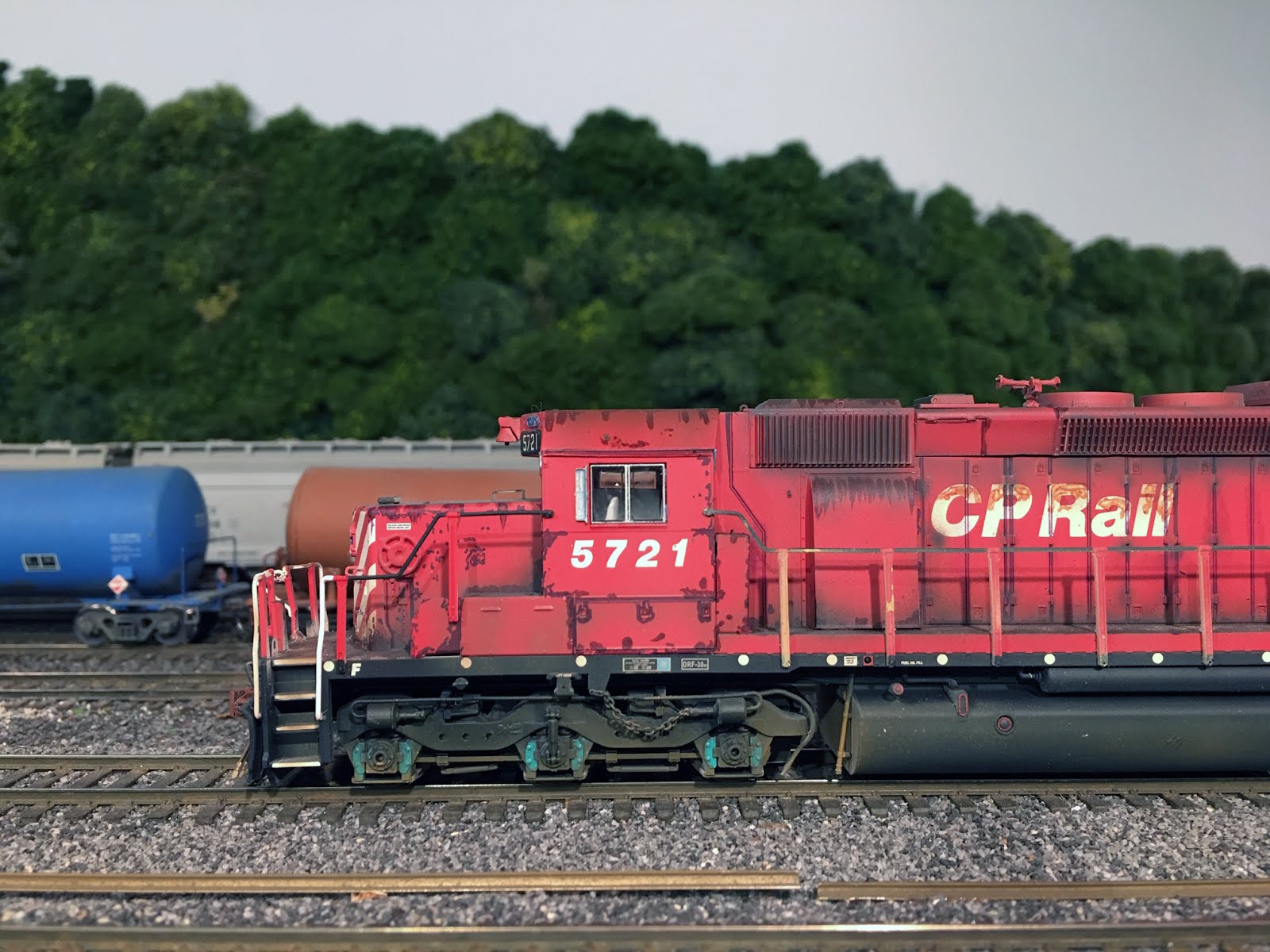
A while ago, as well, I had purchased two Bowser GMD SD40-2's for use as run-through power on the NYS&W trains that interchange with Conrail on the Onondaga Cutoff.  Here's a worn and dirty CP 5721:

Life has its bends and turns, frustrations, and grit.  Looking at this engine gives me joy and appreciation for how great this hobby is these days:  factory-installed lighting like this, let alone the perfect colors and details, AND weathering from a master?


I look up to Lenny's abilities in texture, color and depth.  He can make any material look like any other - truly a master at his craft.  When you take one of his pieces and add it to the fleet, and it ends up in a scene, it speaks for itself:


Yep, that's how that is supposed to look!  Thanks to Lenny, and teamwork in general, the hobby is more fun for everyone.

~RGDave

Tuesday, December 18, 2018

Sometimes It's The Little Things

Layout building is an amalgamation of so many projects, large and small.  After about 10 full years of construction, associated design changes and then operations, I have reached a point where it's hard sometimes to appreciate the some of the smaller projects and details, since I spend so much time thinking and considering the whole thing.  

Thankfully, I'm not alone - this railroad and the operating atmosphere it supports is the product so far of many talented guys (and patient women).  One the regular yard engineers, Joe R., commented on how much he was enjoying operating Conrail GP38 #7714.  It's an Atlas mechanism, well-maintained but otherwise stock.  The decoder is a Soundtraxx Tsunami2, and to it I added the SoundTraxx Current-Keeper capacitor to bridge any dirty track.  

Seeing as though we are on the Albany Division here, while GP38's are great, it's the GE B23-7's that really hold the fort down at most yards.  So, learning from what I'd heard from Joe, I proceeded on a small project:  adding a capacitor to B23-7 #1931, an Atlas unit I'd detailed, renumbered and weathered.  These work alright, but on my isolated frogs with adjacent turnouts, we did have the occasional stall or hiccup, shutting the sound and lights down momentarily and detracting from realism.


1931 has an ESU-LocSound V4 decoder, so I used their 'Power Pack' capacitor board.  The installation is fairly simple and requires a little bit of soldering to the board, and then mounting the capacitor somewhere out of the way inside the shell.  

After the most recent session, the crew spoke highly of #1931 - no stalls, just nice smooth operations.  So, just the addition of a little capacitor circuit made a difference in one of the most critical jobs.  

When we can listen and make small changes to accommodate constructive criticism, I feel we make the hobby more fun for others.  That helps them want to come back.  Is there a greater service we can do for the hobby?  Maybe, but sometimes it's the little things that count.

~RGDave

Friday, November 30, 2018

And To Finish Up November...

Continuing some discussion from the previous posts this month, November started with a bang in the trip to the La Mesa club in San Diego, CA, and then continued with this year's hosting of the 'November Interchange' annual event back in Northern NJ.  This is a round-robin group of modelers and operators from Northern NJ, and from the greater Washington DC areas that operate in one region this year, and the other next year.  This was the second time the Onondaga Cutoff has hosted a session for this event and was a fun success.  Here NYS&W power lays over at Onondaga Yard, before the session began:


In hindsight I should have taken more photographs and especially of the operators doing their thing.  Something to keep in mind for next time!

Other recent projects include putting into service two of the new Scale Trains SD40-2's decorated for Conrail.  They turned out well, and with the Helicon software, even the photos look sharp:


Then, suddenly it was Thanksgiving, my favorite holiday and one that each year is a nice blend of family chaos and low-key community time.  It's hard to overstate just how much it means to be part of a tight community, and I feel a responsibility to help create an environment where good camaraderie and community will flourish.  The same energy carries over to the OC and its operations:  it's people that matter most, and by looking out for others, we create a community for ourselves.  

Over that weekend I was able to get out with the kids to spend some time trackside, something they all enjoy.  Watching them grow is fascinating. We got the last of the fall colors along the Lehigh Line, and even managed to see a few NS freights.


Here's NS train 20R in the S-curve eastbound at Stanton Station, NJ:


Now, on to December!  Lots of good things coming.  Thanks for your readership and time!

~RGDave

Tuesday, November 27, 2018

From West to East

Building upon the early November 2018 trip to San Diego, CA to operate the LaMesa Club's Tehachapi Pass layout, we took a scenic route back to the airport and made time to railfan Cajon Pass in the morning and Tehachapi Pass in the afternoon.  Our first stop was 'Hill 582', a well-known mecca for train watching in Southern California.  On the west side of Cajon Pass, BNSF and UP trains from the east descend steep winding grades into the LA basin, with a backdrop of deserts and mountains.


It's a great vista for trains in both directions from both railroads!  BNSF Eastbound stacks on the former ATSF/UP line, beneath the watch of 10,064 foot Mount Baldy and the San Gabriel Mountains to the north and west:


Then some UP westbounds, up on the former SP "Palmdale Cutoff":


More BNSF westbounds on the former Santa Fe:


It doesn't take long to see trains here, even on a Monday:  the pass can see more than 100 trains daily on three routes owned by UP and BNSF.  It's a great show.

Then, up to Tehachapi.  One of the most magical places to watch trains, and my favorite in the world, so far.  We narrowly missed an eastbound BNSF manifest at Caliente and Bealville, so rushed back uphill to see him cross over his tail headed up Tehachapi Loop:


He took the siding at Walong/Marcel to meet a westbound UP manifest that we chased until sundown.  First, afternoon light at Marcel:


Late afternoon at the Loop:


Downgrade at Allard in the horseshoe curve.  Check out the golden light on the golden wildgrass..."The Golden State" indeed!


One surprise was to see a handful of boxcars lying on their side in the tight curve west of Tunnel 2.  WOW - stuff like that makes you realize how dangerous trains still are.  Trespassing is illegal for a reason!   Sometimes the dramatic shots are trackside, and even when legal, if you'd happened to be there for this event...


I think one of the things that has captivated me about the American West since my youth has been the vastness of it all, and the perspective of loneliness and absolutism that it conveys. I have explored parts of every Western state with the exception of South Dakota (on my list), and I love parts of all of them.  Out here you really can be ALONE - as in hundreds of miles from anyone else - after just a short drive.  The vastness of the scenes and territory dwarfs human ambition more often than not.  If you are out there and you make a mistake, take a fall, run out of gas, etc, you are in real trouble.  Not 'first world trouble' but actual, real trouble.   I love that accountability.  Even railroads, larger than life in so many ways and especially so in the East, out here are just threads of transportation across an incredible landscape.  The men and women that work them need to be prepared for the territory.  

Our train curved out the mountains at Caliente and Ilmon, and headed west. One fascinating part of this is that each of the locations above is faithfully reproduced in HO scale at the LaMesa Club, to the point of being able to recognize specific bluffs and ditches along the scene.  It is spectacular modeling, and an equally spectacular operation.  

A favorite activity trackside has always been to pace trains, and the stretch of high-speed mainline between Bakersfield CA and the foot of the big grades is a perfect example.  Here our manifest is quickly up to 60 MPH, rolling into the setting sun towards a crew change at Bakersfield.  The foothills of the Sierra Nevada range, north of Tehachapi Pass, line the horizon some 10 miles distant.


The trip was coming to a close, and so was this amazing day of watching trains in Southern California.   The smokey and golden sunset backlights our manifest as a green block signal calls the crew home to Bakersfield.  


An amazing month of November continues in the next installment, which I need to squeeze in before December begins.  

More soon!
~RGDave

Monday, November 19, 2018

A Busy Autumn Season

These continue to be amazing times for model railroading, and I continue to be amazed and thankful for some of the new experiences I am continuing to have in the hobby.

First off, at the start of this month, thanks to the graciousness and tenacity of my wife and children, I was able to spend a few days operating on the famous Tehachapi Pass layout of the La Mesa Model Railroad Club, housed in the museum facilities of Balboa Park in San Diego, CA.  Words and photos cannot describe the experience - it's a must see for anyone who enjoys modeling that can get there.


Check out the details.  The tie fenceposts, the earthwork, ballast, and maintenance roadways.

A brief overview of the trip is in order:  we flew out Thursday 11/1 early in the morning so as to have a day to get to the club and assist in staging the railroad for operations on Friday 11/2, Saturday 11/3. and Sunday 11/4.  Thursday night allowed some time to 'get qualified' on the physical characteristics of the railroad - and to be amazed at the scope and scale.  WOW.  For instance, one of the club regulars was moving this 105-car train of refrigerated boxcars ('reefers' in railroad jargon) west to Bakersfield for the following day.   105 cars!  You don't see that every day, and certainly not on an operating mountain railroad.


The railroad climbs about 15 real feet in elevation, close to the correct scale for the actual line.  The scenic feature most recognizable from the pass and the layout is the Tehachapi Loop, a full helix-in-real-life on a 2.5% grade eastbound.  Here an SP manifest comes down the hill, crossing under its own tail as it moves west.


My first solo trip on the railroad on Friday morning was Santa Fe's #23 train, the westbound Grand Canyon, a first-class passenger move.  Since westbounds are superior to eastbounds by timetable direction, I had an easy run with no opposing moves to worry about - they all had to get out of my way!  But even with no waiting, and track speed the entire trip, my journey from Mojave at the east end of the railroad to Bakersfield at the west end took about 45 minutes.   Amazing.


Here that same ATSF train #23 comes down through the lower part of Caliente, CA, having traversed most of the railroad by now.  This scene is one of the most remarkable in all of model railroading, as it is nearly a dead ringer for the prototype.  Caliente in the foreground, the horseshoe curve up the hill, and then successive levels behind the operator in the distance up to Cliff siding, which is a mile away as the crow flies, but 7 miles away by railroad milepost.  Incredible - because that's what we see here, in HO scale!


A good portion of the scenery on the middle areas of the run are above the head of viewers, leading to angles like this one at "Cliff" siding - very appropriately named.


There is no way to really capture the vast expanse of modeling on the railroad, and the attention to detail throughout the finished portions with scenery.  But, here's a tailing off image of ATSF Train 23, with his markers passing the east switch of Ilmon siding.   Bena is ahead with double track from there to Bakersfield.  You get the sense that you are actually running trains on a railroad here, not a layout:  it's so grand in scale to be prototypically vast.

This post is long enough already, so I'll end with a quick reflection.  As time goes on, my definition for 'busy' seems to change.  In the past I used to think I was busy, with different activities demanding time and energy, and yet those times seem to pale in comparison to these days.  Still these things go on, and there's something reassuring about that.  Holidays like Thanksgiving really allow one an opportunity to sit and breathe and appreciate some of the good things that go unnoticed most days.  Walking without pain.  Food to eat.  The colors of nature, the smiles from happy people, the faith of friends and family, and loyalty of pets.

Best wishes to you and yours for a happy and healthy Thanksgiving!

~RGDave