It's a great hobby that allows us to be able to experience new things - in my case, after model railroading for more than 30 years, September 3, 2015 still will stand out: We had our first operating session with fully remote dispatching.
Thanks to the internet and the capable networking skills of J. Alex Lang, as well as the signal design skills of Nick Anshant, the Onondaga Cutoff was remotely dispatched via CATS/JMRI software and radio from Jacksonville, FL for the first part of the session, and Pittsburgh, PA to close things out. Crews talked into the radio, and by wiring a radio to the computer and Skype software, the remote DS could hear crews and talk back to the radio. The DS lined switches and signals on their computers, and hardware moved on the OC.
More to come on this soon, but this was just too exciting not to mention immediately!
~RGDave
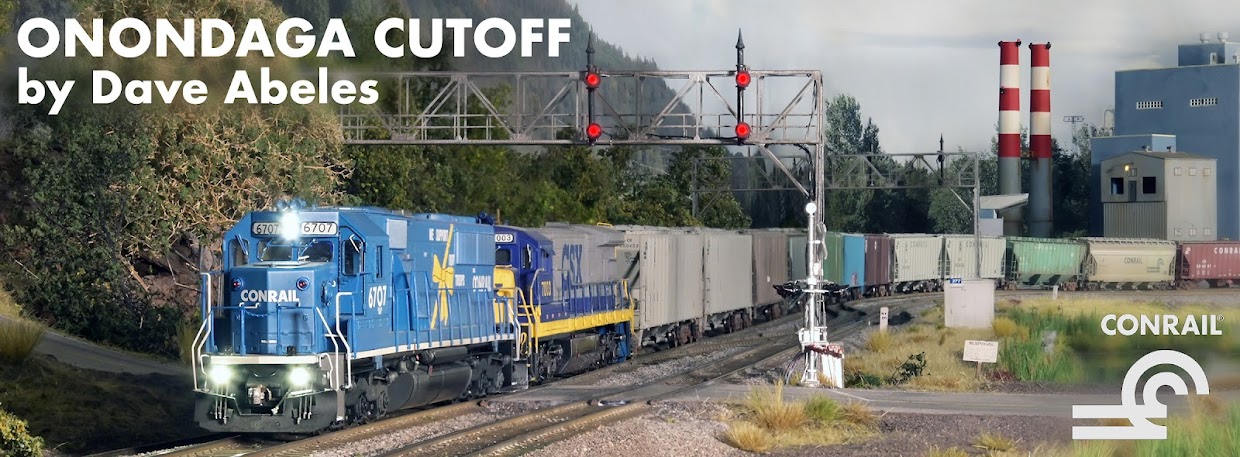
Preparation and construction of a basement-sized, HO-scale model railroad based on Conrail's operations through Central New York on the Chicago Line in 1994.
Friday, September 4, 2015


Thursday, August 27, 2015
A Little Progress is Still Progress
Summertime with a young family, and an extended community with many teachers, is a time of weekend trips, camping, and family activities. Between that and working full time, summer months are not a high-volume production time for the Onondaga Cutoff.
However, there is still time to do a bit here and a bit there, and those bits add up. Here's a late afternoon photo of recent scenery construction west of CP-280.

A few more trees have grown in on the hillside, and I am wrapping up the first layer of ballast for the east end of the major yard on the railroad, including leads into CP-280. Ballasting interlockings is a painstaking process, worked on a few ties at a time, all while working to get the colors and profiles correct despite avoiding stones and glue on moving parts of interlocked turnouts. This is the first layer of ballast in the yard, with smaller crushed 'walking' stones yet to come as a finishing touch near the ladders and North Runner (the track running on the right side of the ladder tracks into the distance).
Enjoy the waning days of summer!
~RGDave
However, there is still time to do a bit here and a bit there, and those bits add up. Here's a late afternoon photo of recent scenery construction west of CP-280.

A few more trees have grown in on the hillside, and I am wrapping up the first layer of ballast for the east end of the major yard on the railroad, including leads into CP-280. Ballasting interlockings is a painstaking process, worked on a few ties at a time, all while working to get the colors and profiles correct despite avoiding stones and glue on moving parts of interlocked turnouts. This is the first layer of ballast in the yard, with smaller crushed 'walking' stones yet to come as a finishing touch near the ladders and North Runner (the track running on the right side of the ladder tracks into the distance).
Enjoy the waning days of summer!
~RGDave
Friday, August 14, 2015
Summertime, Again!
Over the last few years, a pattern has developed that limits layout time during the summer. With so many outdoor activities going on, and all sorts of family gatherings and weekend trips to organize, time for progress on the Onondaga Cutoff is limited. Still, I aim each day to make some sort of effort to move things along, however small that may be.

This car has a neat story: At the last operating session, an operator donated a car from his freelanced shortline to my roster. It's a great model that he lettered and weathered himself. All I had to do was install the resistive wheelsets for block detection on my layout. CPN 2016 will enter sand service on the Onondaga Cutoff. And, while I was at it, I finally finished up the PC flatcar at right with heavy weathering as well as resistive wheesets. The PC flat will enter the MOW fleet. Both of these were relatively quick projects - a total of 1 hour spread over three nights - that help to keep progress moving on the layout.
A recent locomotive project was to model a Union Pacific SD40-2, to add to the fleet of run-through locomotives on the roster. This engine came factory decorated from Intermountain as UP 3367, but in the as-delivered paint job from the 1970's. Following great advice from Joe Atkinson, I removed the lettering and added decals to bring the engine to its appearance in the mid-90's. Here it is, ready for weathering!

In addition to rolling stock, small windows of time are perfect for adding small details that help a layout stand out. I finally got around to adding the joint bars to represent insulated joints at CP 282, beneath the big signal bridge there. The joints, while subtle, really make the scene more complete, at least to my eye!


This car has a neat story: At the last operating session, an operator donated a car from his freelanced shortline to my roster. It's a great model that he lettered and weathered himself. All I had to do was install the resistive wheelsets for block detection on my layout. CPN 2016 will enter sand service on the Onondaga Cutoff. And, while I was at it, I finally finished up the PC flatcar at right with heavy weathering as well as resistive wheesets. The PC flat will enter the MOW fleet. Both of these were relatively quick projects - a total of 1 hour spread over three nights - that help to keep progress moving on the layout.
A recent locomotive project was to model a Union Pacific SD40-2, to add to the fleet of run-through locomotives on the roster. This engine came factory decorated from Intermountain as UP 3367, but in the as-delivered paint job from the 1970's. Following great advice from Joe Atkinson, I removed the lettering and added decals to bring the engine to its appearance in the mid-90's. Here it is, ready for weathering!


Much more challenging projects are on the horizon as we head into autumn in New Jersey. With the help of my daughter Susie, I started to make more background trees to continue scenic progress behind Onondaga Yard, and will need several hundred more of those for scenery to continue on the M&E. There are also a variety of locomotive projects at hand, including a relatively challenging kitbash to create GE C30-7A's in the Conrail livery. Plenty of updates to come!
~RGDave
Thursday, July 23, 2015
Modeling Modern Details
Model railroading is not a 'new' hobby - in some form it has been around for more than 100 years, and the hobby - like the industry - has changed over the years. In the 1940's and 1950's, route-mileage peaked on the prototype, with spurs and branches into almost every town in America. I can see where this would be a great era to model.
However, much of America's manufacturing base moved away from railroads before 1990, and that is what my generation grew up with. We know very well that modern railroads have as many abandoned spurs as they do active ones, and a plausible eastern model railroad set in 1994 needs some abandoned spurs.

Details available to us today are remarkable and make the hobby very rewarding. Here is a recent detail project that I completed on the M&E, replacing a frog on an 'abandoned' turnout with a section of jointed rail. Frogs are high-maintenance items, and if there is no use of a side track, railroads can reduce track maintenance costs by removing the frog even if some of the rest of the turnout remains. I used Details West rail joiner bar models to 'bolt' the new rail in place of the frog on this Shinohara #6 switch, and with the addition of some ballast and some grit, grime, and weeds, we have a nice mini-scene that helps illustrate the era of the railroad.
More details like these will follow as time passes - always plenty to keep us busy on the Onondaga Cutoff.
~RGDave
However, much of America's manufacturing base moved away from railroads before 1990, and that is what my generation grew up with. We know very well that modern railroads have as many abandoned spurs as they do active ones, and a plausible eastern model railroad set in 1994 needs some abandoned spurs.

Details available to us today are remarkable and make the hobby very rewarding. Here is a recent detail project that I completed on the M&E, replacing a frog on an 'abandoned' turnout with a section of jointed rail. Frogs are high-maintenance items, and if there is no use of a side track, railroads can reduce track maintenance costs by removing the frog even if some of the rest of the turnout remains. I used Details West rail joiner bar models to 'bolt' the new rail in place of the frog on this Shinohara #6 switch, and with the addition of some ballast and some grit, grime, and weeds, we have a nice mini-scene that helps illustrate the era of the railroad.
More details like these will follow as time passes - always plenty to keep us busy on the Onondaga Cutoff.
~RGDave
Monday, July 6, 2015
Marking the Rear End
A project that has been on the back burner for a while has been adding working marker lights to the rear end of my Amtrak train consist, in accordance with NORAC rules. Amtrak is a tenant on the Onondaga Cutoff. Conrail maintains the track, and Amtrak uses the Conrail main line for their Empire Service. Any passenger train needs to have red marker lights displayed on the hind end, and while the new Walthers Amfleet cars come with the lenses installed, there is no provision for the distinctive red lights themselves.

These cars come beautifully detailed, but lighting was not included. Walthers does sell a nice LED light board designed for these models specifically, and the cars include trucks and pick-up contacts installed from the factory. Adding to the frustration is the tab system they include does not hold up to the installation process. I therefore hard-wire the contacts between the frame and the board, which has proven to be much more reliable.
For the hind end, though, lighting wasn't the only thing required. Marker lights were still needed. I therefore purchased a set of Miniatronics red surface-mount LED's pre-wired with leads, and included resistors to get the light to the correct intensity. The results are worth it!

Lining this up was more work than it should have been, compounded by the fragility of the contacts and hiding wiring from view through the side windows. But, in the end, now Amtrak 273 & 276 running via the Onondaga Cutoff will have the hind end properly defined!
~RGDave
Wednesday, June 10, 2015
Context, Details, and Maintenance Equipment
One of the things that working for a railroad can give you is lots of opportunity to observe the machines and people that make a railroad work - besides the trains! While we all enjoy the trains themselves, the fact is that trains wouldn't roll if the property were not properly maintained. Different departments work to maintain different aspects of the operation: Track, 'B&B' (Buildings and Bridges), Signals, etc.
Scenery around the west end of Onondaga Yard has continued to progress. With each small improvement, the context of the layout deepens. Here's an overview of the scene at the big signal bridge supporting the westbound home signals for CP282, showing new ballast work, and the newly installed access road for the yard office:


And finally, here is a close-up of the knuckle boom, the most recent and most intricate of the three models that Mark has delivered:

I am looking forward to getting more background and base scenery done, as it allows some of the real scenic detail work to begin in earnest. All of that helps to set the feel of Conrail in the 1990's, as well as the feel of the area of Central New York that I am trying to convey.
~RGDave
Scenery around the west end of Onondaga Yard has continued to progress. With each small improvement, the context of the layout deepens. Here's an overview of the scene at the big signal bridge supporting the westbound home signals for CP282, showing new ballast work, and the newly installed access road for the yard office:

And a quick snapshot of the signal bungalo for CP282, which has taken the place of the abandoned interlocking tower in the background:

In that first image, you can see a big knuckle-boom truck on the access road, headed towards the maintenance base that occupies some of the yard office area. Built by my long-time buddy Mark in exchange for some weathering and DCC work, I only added some decals, window glass, and weathering to finish up his truck models for my fleet, each of which include scratchbuilt, resin-cast cabs, with kitbashed frames, wheels, and body.
Here's a few shots of the current fleet at rest at the office. First is a shot showing the rest of that area, which ends up being a good place to display the trucks behind the west end of the yard:

The trucks are not motorized, but are really beautiful models, with plenty of details! Having a few of them fills a crucial role of adding important background for Onondaga Yard. Most Conrail facilities would have a few trucks like these around, and Onondaga is no exception. Here is a close-up of the boom truck:

And finally, here is a close-up of the knuckle boom, the most recent and most intricate of the three models that Mark has delivered:

I am looking forward to getting more background and base scenery done, as it allows some of the real scenic detail work to begin in earnest. All of that helps to set the feel of Conrail in the 1990's, as well as the feel of the area of Central New York that I am trying to convey.
~RGDave
Tuesday, June 2, 2015
Scenery & Close Clearances
Model railroaders always need more space. I do, anyway. Even where there seems to be plenty of space, we always squeeze in as much as we can, and Onondaga Yard is no exception. Most of the Onondaga Cutoff will be built with narrower scenes than at Onondaga Yard, where I have almost 30" of space to work with between the front the fascia and the backdrop. All that space is used by trackage in an effort to maximize capacity and efficiency at the yard itself.
This caused a bit of a challenge regarding scenery at the closest spot. I want to model a wooded hillside behind the yard, based on what the scenery at Ram's Gulch looks like south of Syracuse where the railroad would run. But cars were brushing against my test areas - even basic foliage requires more space than I allowed myself! I decided a good solution would be to have a retaining wall at the tightest spot, modeled quickly from sheet styrene.

As you can see, after painting the styrene to represent aged concrete, and tracing some construction joints along the painted surface with a fine permanent marker, I simply glued the wall to the backdrop. In the photo above I have started to fill in trees around the 'wall' which allows the hillside to look complete even where I did not have space for the trees. Tracks here are, from right to left, the North Runner, and Park Yard tracks 4, 3, 2, and 1. The painted backdrop above will soon be filled with foliage. Here's a tighter view from track level:


Finally, a quick shot from the aisle looking across the yard towards the backdrop. Once this is filled with foliage, and then accented with the more finely-detailed 'super trees,' this scene will start to pop like the scene at CP 282 does now. Then I can ballast the yard, add the access road and miscellaneous details, and step back to enjoy the view of long trains passing before moving on to the engine house scene!
~RGDave
This caused a bit of a challenge regarding scenery at the closest spot. I want to model a wooded hillside behind the yard, based on what the scenery at Ram's Gulch looks like south of Syracuse where the railroad would run. But cars were brushing against my test areas - even basic foliage requires more space than I allowed myself! I decided a good solution would be to have a retaining wall at the tightest spot, modeled quickly from sheet styrene.

As you can see, after painting the styrene to represent aged concrete, and tracing some construction joints along the painted surface with a fine permanent marker, I simply glued the wall to the backdrop. In the photo above I have started to fill in trees around the 'wall' which allows the hillside to look complete even where I did not have space for the trees. Tracks here are, from right to left, the North Runner, and Park Yard tracks 4, 3, 2, and 1. The painted backdrop above will soon be filled with foliage. Here's a tighter view from track level:

The yard is without ballast or other details until the backdrop is complete. Scenery is a messy process, and I want to avoid having to repair spills or damage on the ballast and track while working on the backdrop. Here is a view west towards the Yard Office.

Finally, a quick shot from the aisle looking across the yard towards the backdrop. Once this is filled with foliage, and then accented with the more finely-detailed 'super trees,' this scene will start to pop like the scene at CP 282 does now. Then I can ballast the yard, add the access road and miscellaneous details, and step back to enjoy the view of long trains passing before moving on to the engine house scene!
~RGDave
Subscribe to:
Posts (Atom)