...was completed over the weekend, just in time to run a few trains Sunday evening! This required that the bridge be painted and weathered. The final product turned out very well. Photos to come soon.
In testing, I tried a train of 30 cars and had no issue, and a train of 51 cars, which had a few issues for lighter cars at the front of the train. Once those cars were moved towards the rear of the train, I was able to run a 3-unit lashup with 51 cars with no issues at all. That is longer than most of my trains will be, but it's nice to know I can do it! The sound of that many metal wheels was neat!
I will be laying Track 1 around the remainder of the mainline, and upgrading locomotives as time allows. Next comes the full wiring of the main, and then the installation of switch machines and their wiring.
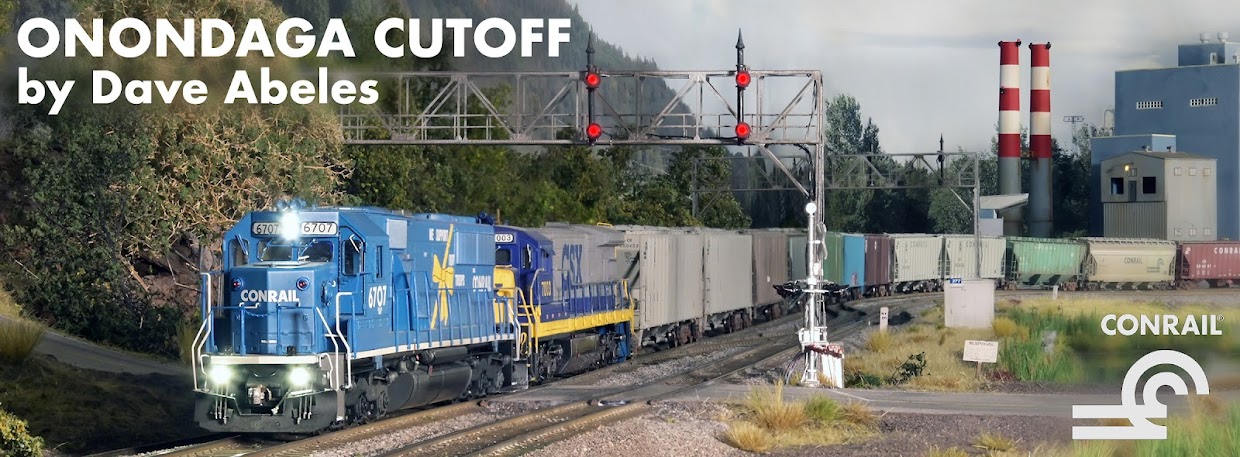
Preparation and construction of a basement-sized, HO-scale model railroad based on Conrail's operations through Central New York on the Chicago Line in 1994.
Tuesday, June 1, 2010


Wednesday, May 26, 2010
'The Light at the End of the Tunnel'
All interlocking switches are now in place - we're getting closer and closer to having the mainline track complete.
 Working east around the big curve, I thought an overview would be helpful for you to see where things stand now. Track 2, the closer mainline track, is in place around the majority of the curve now, with staging below:
 On the other current 'end of track', working west, is CP 277, freshly laid in place as a basic universal crossover. This will allow trains to work around each other when the local is out on the line, or when a big freight is tying up a main track while working Onondaga Yard. Tracks to the left and right are staging leads and will not be visible once scenery is in place:
 One of the things that having the mainline complete will allow is operating 6-axle power for the first time in years. In advance of that, I have started to change out all the old Athearn sintered iron wheelsets to nickel-plated brass wheels, made by Northwest Short Line. Here is Conrail SD50 6789 with her new shoes:
 The track looks pretty toy-like, right? I put a bit of old ballast down to see how that looked. It's too white, and still, the track needs weathering. All those things in good time :-) For now, here's 6789 positioned westbound approaching CP 277 with some ballast down:

And, finally, a shot of 6789 again, this time positioned on the big, superelevated curve westbound coming into CP 280: Before long, it will be time to weather the 9-Mile Creek bridge and install the bridge track to complete the main line. Then I can run big trains while working on wiring, yard tracks, backdrop, and upgrading locomotives...but at least there will be trains running!
Here is a view of all mainline track at CP 280, east end of Onondaga Yard, looking east. Yard tracks to the left are not laid yet. I have placed them there there as space holders:

I built west from CP 280 and am now laying Track 2 around the final big curve towards the 9-Mile Creek bridge, and simultaneously I put in CP 277 and am working west towards the same location. But there won't be a 'golden spike' ceremony when east meets west - that will wait for the new control system, backdrop, and a small section of finished scenery to host the 'official' event.
Looking back west, with the mainline to the left and preliminary yard tracks to the right, and CP 280 in the foreground:
Working east around the big curve, I thought an overview would be helpful for you to see where things stand now. Track 2, the closer mainline track, is in place around the majority of the curve now, with staging below: On the other current 'end of track', working west, is CP 277, freshly laid in place as a basic universal crossover. This will allow trains to work around each other when the local is out on the line, or when a big freight is tying up a main track while working Onondaga Yard. Tracks to the left and right are staging leads and will not be visible once scenery is in place: One of the things that having the mainline complete will allow is operating 6-axle power for the first time in years. In advance of that, I have started to change out all the old Athearn sintered iron wheelsets to nickel-plated brass wheels, made by Northwest Short Line. Here is Conrail SD50 6789 with her new shoes:The track looks pretty toy-like, right? I put a bit of old ballast down to see how that looked. It's too white, and still, the track needs weathering. All those things in good time :-) For now, here's 6789 positioned westbound approaching CP 277 with some ballast down:And, finally, a shot of 6789 again, this time positioned on the big, superelevated curve westbound coming into CP 280:
Before long, it will be time to weather the 9-Mile Creek bridge and install the bridge track to complete the main line. Then I can run big trains while working on wiring, yard tracks, backdrop, and upgrading locomotives...but at least there will be trains running!Monday, May 17, 2010
More Tracklaying...
This weekend, I finished installing the second-to-last interlocking for the main line. CP280 went in and cured overnight - tonight I will remove the weights, and begin laying track around the big turn 'east' from Onondaga Yard, around past the industries of Hampton and BPA, and across the 9-mile creek bridge. The truss for 9-mile Creek will be painted silver and heavily weathered to represent a mid-90's look of other ex-NYC through truss bridges in Central New York.
We can see here some other minor plan adjustments as the work continues - the proposed lengthening of the short line, as well as an angle to the engine yard, etc. Actual yard layout will be modified to use what track I have access to.
More photos will come soon as I near the completion of the main line!
Monday, April 26, 2010
CP 282 - Track is In!
Over the course of a week or two of evenings, I have been able to align all the switches for CP 282, the west end of Onondaga Yard and the junction with the Minoa & Euclid Railroad, which will eventually be built to interchange with Conrail's Onondaga Cutoff.
 Interlockings take a long while to install, because it needs to be right the first time, and it involves everything at once: both tracks, sidings, switch machines, and eventually, signals. Everything, including predrilled holes for switch machines, has to be located exactly before any piece of track can be permanently fixed in place. I like this view of the new infrastructure:
 A recent article in Model Railroader was written by a modeler who never used commercial flex track or switches, preferring to have the realism offered by hand-laying. Recently he needed to finish a new addition to his layout quickly and had to use commercial products, and wrote an article on how he made them work with his design. One idea of his that I used over the weekend was to modify commercial switches to flow better with my design at the east end of CP 282 - this is a Shinohara (Walthers) #8 frog, left-hand switch. I cut the long ties on the far side of the frog with a razor saw, used a utility knife to remove the tie spacers beneath the rails, and then gently and patiently curved the main route and diverging route to match the adjacent curves. I am very happy with the results - subtle, but crucial to the future alignment.
 On the far side of CP 282, along what will be Onondaga Yard, the mainline makes a sweeping curve. I use masking tape, layered and staggered by several inches on each end to 'step up' to the full superelevation gradually at both ends of the curve. Pictured here, Track 1 has the tape installed, while Track 2 to the left is waiting for tape.
 So, the interlocking at CP 282 is now in place, though not yet operational. Here is the overview for an eastbound train. The North Runner for Onondaga Yard comes off on the left in this view, and the connector to the M&E is on the right in the middle distance:

Pictured below is the west end of the interlocking, the point at which the mainline will curve to the right, pass beneath a highway bridge, and begin the 2% drop down to staging.
 Interlockings take a long while to install, because it needs to be right the first time, and it involves everything at once: both tracks, sidings, switch machines, and eventually, signals. Everything, including predrilled holes for switch machines, has to be located exactly before any piece of track can be permanently fixed in place. I like this view of the new infrastructure: A recent article in Model Railroader was written by a modeler who never used commercial flex track or switches, preferring to have the realism offered by hand-laying. Recently he needed to finish a new addition to his layout quickly and had to use commercial products, and wrote an article on how he made them work with his design. One idea of his that I used over the weekend was to modify commercial switches to flow better with my design at the east end of CP 282 - this is a Shinohara (Walthers) #8 frog, left-hand switch. I cut the long ties on the far side of the frog with a razor saw, used a utility knife to remove the tie spacers beneath the rails, and then gently and patiently curved the main route and diverging route to match the adjacent curves. I am very happy with the results - subtle, but crucial to the future alignment. On the far side of CP 282, along what will be Onondaga Yard, the mainline makes a sweeping curve. I use masking tape, layered and staggered by several inches on each end to 'step up' to the full superelevation gradually at both ends of the curve. Pictured here, Track 1 has the tape installed, while Track 2 to the left is waiting for tape. So, the interlocking at CP 282 is now in place, though not yet operational. Here is the overview for an eastbound train. The North Runner for Onondaga Yard comes off on the left in this view, and the connector to the M&E is on the right in the middle distance:
And, finally, the view a westbound will have of the whole plant at CP 282, with the South Runner for the yard coming in at the bottom right. This view allows one to readily see the route that M&E trains will take to interchange.
 As always, more to come - each rainy weekend allows some time to make some progress!
As always, more to come - each rainy weekend allows some time to make some progress!Monday, April 12, 2010
Springtime has arrived
And with springtime comes some time constraints for layout-time! Spring cleaning, gardens, cutting the lawn, outdoor improvements, and the like start again in earnest. But, today, the last turnouts I need to complete the mainline will arrive, and tracklaying should start again soon (once I finish editing my photos from a great trip my wife and I took recently to Australia & New Zealand). All the mainline roadbed is now in place.
My goal is for the first train to traverse the entire, completed mainline within 2 months time. Then work will begin on laying yards and sidings. Once everything is smooth, I will be making the big switch to DCC.
2010 is becoming an exciting year for the Onondaga Cutoff!
My goal is for the first train to traverse the entire, completed mainline within 2 months time. Then work will begin on laying yards and sidings. Once everything is smooth, I will be making the big switch to DCC.
2010 is becoming an exciting year for the Onondaga Cutoff!
Friday, February 26, 2010
More Tracklaying...
Now that the main line benchwork is complete, my plan is to lay all mainline track and interlockings, wire the entire mainline, and install all switch machines and associated wiring before installing yard tracks, sidings, or the backdrop. This approach lets me run full-size test trains on conventional DC power to make sure the trackwork is bug-free and that the wiring is up to snuff. The open feel of the layout now will be helpful to track trains during the test phase.
Here is a photo of the recently installed 'final link' in the mainline sub roadbed, with staging below, and Onondaga Yard on the far side of the studs (which will eventually be backdrop):
 And an overview of the Onondaga Yard area, with new roadbed just installed for both mainlines as well as some track and switches with which I was experimenting for yard layout:
 Roadbed is now continuous from staging up to the top level. Here is the back staging ramp west of CP 282 and the protective wall (aluminum flashing, stapled to the studs):
 I have decided to use traditional cork roadbed instead of foam under my mainline interlockings. The issue with the foam is that it is relatively compressible, and as such does not offer the best support for the switches. While the ride will be a bit rougher on the turnouts over cork, the whole structure will be more firm and I think that will be better in the long run.
Here is a photo of the recently installed 'final link' in the mainline sub roadbed, with staging below, and Onondaga Yard on the far side of the studs (which will eventually be backdrop):
And an overview of the Onondaga Yard area, with new roadbed just installed for both mainlines as well as some track and switches with which I was experimenting for yard layout:Roadbed is now continuous from staging up to the top level. Here is the back staging ramp west of CP 282 and the protective wall (aluminum flashing, stapled to the studs): I have decided to use traditional cork roadbed instead of foam under my mainline interlockings. The issue with the foam is that it is relatively compressible, and as such does not offer the best support for the switches. While the ride will be a bit rougher on the turnouts over cork, the whole structure will be more firm and I think that will be better in the long run.
Looking 'railroad east' we see the road bed of CP280, ready for mainline track:
 And this time, with some loose track placed on top so we can see the general interlocking plant at CP 282. The yard leads are to the left here, and the connector to the eventual shortline to the right:
 And a few the other way, 'railroad west' of CP282. None of the track here is secured in place, it is just placed atop the roadbed:
 Finally, too, with all main line subroadbed down, it was time to place the thru-truss for Nine Mile Creek. I selected a spot on a short tangent, quite a distance from any interlocking, out on the raised portion of the inner curves. The river will come through from behind the bridge to the edge of the layout and flow east along the mainline. I really like the way this looks so far:
 The track across the bridge will be Micro-Engineering Code 83 'bridge track' which includes the oversize timbers as well as ribbon guard and guard rails. It comes in 36" pieces, and I won't cut it down until I am ready to finish the track through the area. It's going to look awesome.
 And this time, with some loose track placed on top so we can see the general interlocking plant at CP 282. The yard leads are to the left here, and the connector to the eventual shortline to the right:And a few the other way, 'railroad west' of CP282. None of the track here is secured in place, it is just placed atop the roadbed:
 Finally, too, with all main line subroadbed down, it was time to place the thru-truss for Nine Mile Creek. I selected a spot on a short tangent, quite a distance from any interlocking, out on the raised portion of the inner curves. The river will come through from behind the bridge to the edge of the layout and flow east along the mainline. I really like the way this looks so far: The track across the bridge will be Micro-Engineering Code 83 'bridge track' which includes the oversize timbers as well as ribbon guard and guard rails. It comes in 36" pieces, and I won't cut it down until I am ready to finish the track through the area. It's going to look awesome.
I used some scrap lumber cut to size to temporarily support the truss; these will soon be stone abutments, set in place on the plywood. Track laying cannot be finished until the bridge is weathered and permanently in place.
More to come - winter is a great time for layout progress!
Tuesday, February 23, 2010
Benchwork...complete!
Finally...all the main line benchwork is in place, ready for track laying, and thought has turned to finalizing the yard and interlocking design now, in between laying more roadbed. 

Here is the new proposed arrangement of the west end of Onondaga Yard and CP282. Note the lay out of the crossovers and yard access, as well as the two separate yard ladder tracks, which will allow two trains to work the yard and stay out of each other's way to the maximum degree possible. Thanks to Jack for the ideas and design help!
More photos to come soon of the new subroadbed and track work as things progress.
Subscribe to:
Posts (Atom)