Wednesday, February 25, 2026

A Year of Milestones

2026 is shaping up to be a year with a lot of commemorative anniversaries - milestones, if you will, marking progress along a journey.  Like the railroad mileposts today, milestones back in the early days of canals and turnpikes helped travelers keep track of progress, and to know where they were along the route.  The markers also helped them to realize how far they had come, and perhaps how much further they would need to go.  

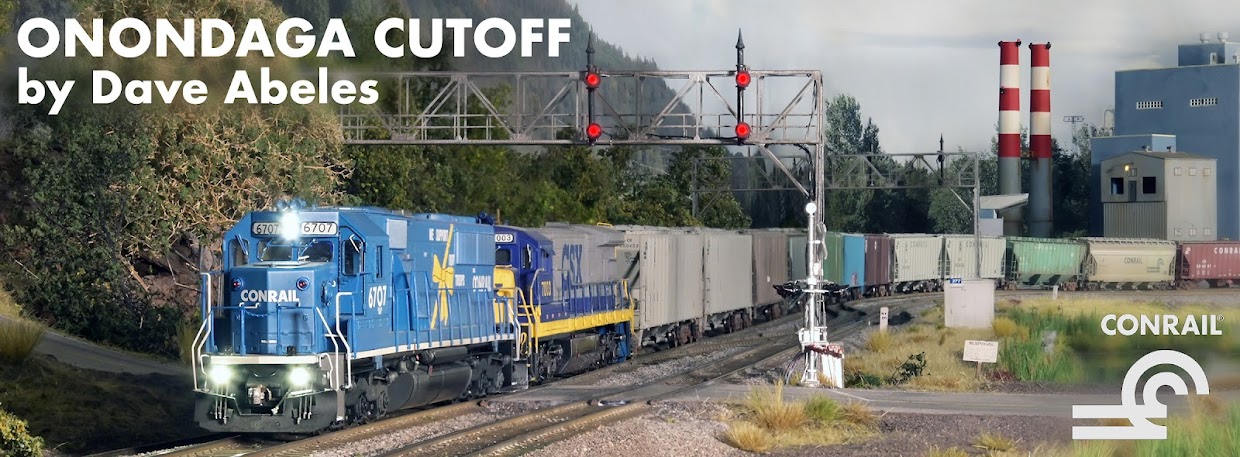
There is more to unpack on that topic.  Future posts this year will no doubt delve further into those discussions.  Today however I wanted to share a surprise honoring one of the important anniversaries this year:  the 50th anniversary of the creation of Conrail, the prototype railroad for the Onondaga Cutoff.  

The surprise is that one of my articles made the cover of Model Railroader magazine with my piece honoring Conrail's anniversary!


Conrail was created by the US government in 1976 in an effort to save the industry.   Railroads were going bankrupt at an alarming rate and change was needed.  And the changes worked, despite hardships.  The hard work and sacrifices by managers and labor brought the railroad back.  We've discussed it here before, and it remains a compelling story.  50 years later, there is a lot to consider.

Cover shots, meanwhile, are kept as a surprise each month for the lucky photographer whose work is chosen by the editorial staff to grace the cover.  It is fulfillment of a boyhood dream - really a lifelong dream - to have this experience.  And now to have it happen in honor of the birthday of the railroad we model on the OC?  This one is a new high that connects more than one world for me.  I am so grateful for what the OC has become, thanks to a group of railroaders and modelers that have put uncounted hours into planning, operating, and maintaining the railroad.  In a year of milestones, this is a big one for us.  

It's only February, but this sure is an exciting way for momentum to build into 2026.  More milestones to come.  We are honored to start with this one!

Wednesday, February 11, 2026

Some scenery at CP 274

 As operations have continued on the Onondaga Cutoff, there is room for some scenery improvements as well.  Originally staging areas were imagined to remain without any scenery, instead just having the subroadbed painted black. The safety rerailers are working well, and I had installed some backdrop pieces as a view block, but it was a minimal scene in all respects.


And yet as guests have offered comments, I learned that my mind's eye of the railroad was different than the perception of visitors.  One offered that he appreciated the little bit of scenery I had added in part of staging as it added to what he considered to be his total run.  I noted that the rerailers, part of the Walthers grade crossing kit, were cast in a color that suggested concrete.  Those could be blended into a grade crossing scene, one of the smaller ones that would be used by crews and the mechanical department to facilitate trains getting under way.  

Maybe this little scene could have some merit, too.   

I started by adding ballast, my chosen mainline blend from Arizona Rock & Mineral:  UP Silverton, #1351 N scale sized and 1352 for HO.  The color palate is perfect for what Conrail used along the Chicago Line in the '90's and the mix of sizes matches the visual.  


This process is iterative, little by little.  I used a small brush to spread the ballast and a piece of internal packing foam from an old Athearn blue box locomotive to regulate the ballast.  Care is needed near switches especially.  I used a plastic spoon to drop in a very small amount of ballast stone around the points which ensures the ballast stays below the top of the ties.  


Once the ballast surface is smooth and the points are clear, it is time for glue.  The first step is a generous misting with isopropyl alcohol.  This step allows the white glue diluted with water to avoid surface tension and smoothly soak into the ballast.  Add the glue generously but gradually.   Now, it looks like a real mess when you've soaked it - but that will dissipate overnight, before fully curing after about 36 hours.   


Once the ballast is in place, adjacent scenery can be installed and similarly flooded with glue.  I used N-scale yard mix and black cinders for the adjacent lot and access road, finished with a bunch of different grass tufts.  This whole scene then sits for 36 hours to cure fully.  


The results, though, are great.  I have added a 'tank' to the column to the left, per Kristen's suggestion, which is a great one.  While the wide-angle lens makes it appear tilted, it is level and will be labeled with the logo for the Chittenango NY Water Authority.  Signage from ScaleSigns and LTI Inc helps complete the scene as well.

This process will continue to ensure that CP274 is loaded with scenery before the end of the winter, and that same process can then move up to Iroquois Paper to finalize that before tackling the last big area: Fayetteville. Plenty more to come!